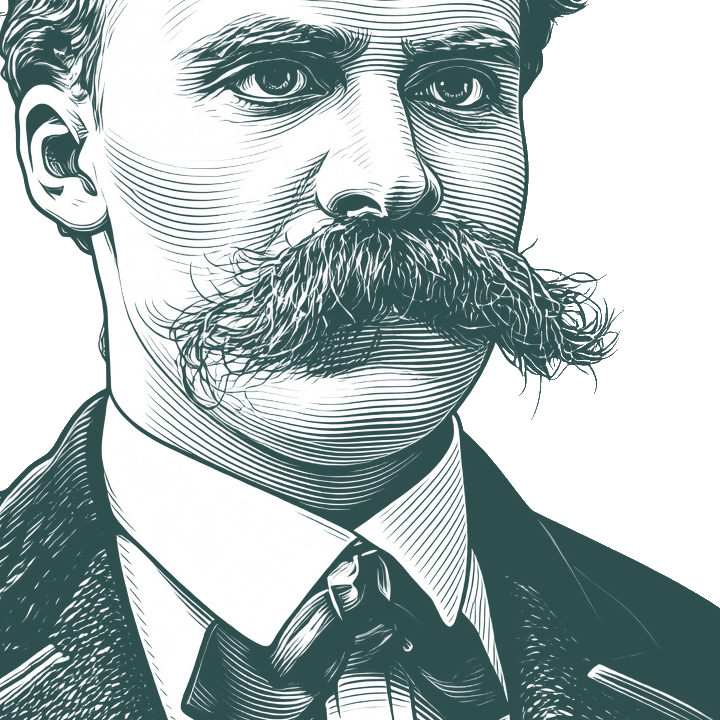
Often they descended to their grave with an ironic smile – for what was there left of them to bury! Only the dross, refuse, vanity, animality that ha… - Friedrich Nietzsche
""
Often they descended to their grave with an ironic smile – for what was there left of them to bury! Only the dross, refuse, vanity, animality that had always weighed them down and that was now consigned to oblivion after having for long been the object of their contempt. But one thing will live, the monogram of their most essential being, a work, an act, a piece of rare enlightenment, a creation: it will live because posterity cannot do without it. In this transfigured form, fame is something more than the tastiest morsel of our egoism, as Schopenhauer called it: it is the belief in the solidarity and continuity of the greatness of all ages and a protest against the passing away of generations and the transitoriness of things.
English
Collect this quote
About
Friedrich Nietzsche
Friedrich Wilhelm Nietzsche (15 October 1844 – 25 August 1900) was a German philosopher, cultural critic, composer, poet, writer, and philologist whose work has exerted a profound influence on modern intellectual history. His critiques of contemporary culture, religion, and philosophy centered on a basic question regarding the foundation of values and morality.
Biography information from
Wikiquote·
Portrait adapted from
Wikimedia Commons, Friedrich Hermann Hartmann (Public domain / CC0)
Also Known As
Alternative Names:
Friedrich Wilhelm Nietzsche
•
Nietzsche
Knowledge kills action; action requires the veils of illusion.
There are terrible people who, instead of solving a problem, bungle it and make it more difficult for all who come after. Whoever can't hit the nail on the head should, please, not hit at all.
Limited Time Offer
Premium members can get their quote collection automatically imported into their Quotewise collections.
"Nothing is needed more than truth, and in relation to it everything else has only second-rate value."
This unconditional will to truth — what is it? Is it the will not to allow oneself to be deceived? Or is it the will not to deceive? For the will to truth could be interpreted in the second way, too — if only the special case "I do not want to deceive myself" is subsumed under the generalization "I do not want to deceive." But why not deceive?
But why not allow oneself to be deceived?
Note that the reasons for the former principle belong to an altogether different realm from those for the second. One does not want to allow oneself to be deceived because one assumes that it is harmful, dangerous, calamitous to be deceived. In this sense, science would be a long-range prudence, a caution, a utility; but one could object in all fairness: How is that? Is wanting not to allow oneself to be deceived really less harmful, less dangerous, less calamitous? What do you know in advance of the character of existence to be able to decide whether the greater advantage is on the side of the unconditionally mistrustful or of the unconditionally trusting?