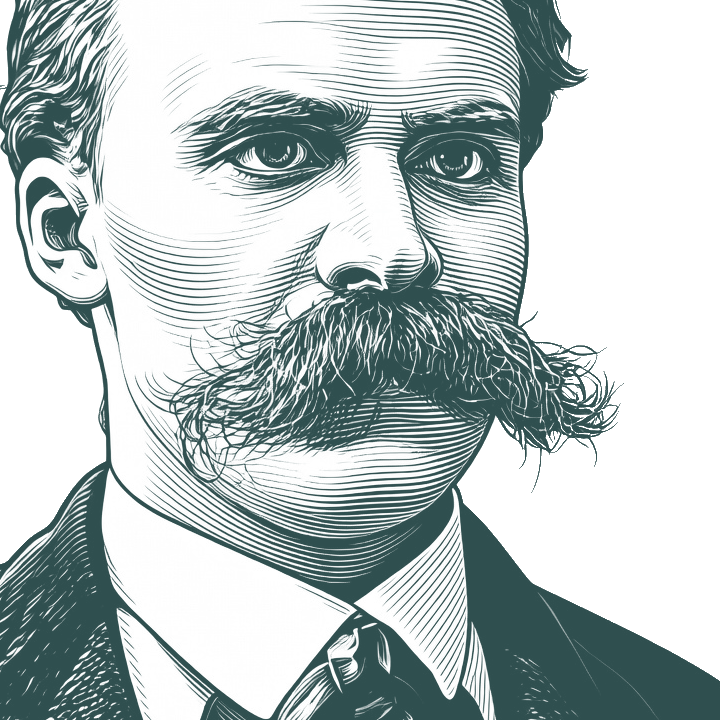
Physiologists should think before putting down the instinct of self-preservation as the cardinal instinct of an organic being. A living thing seeks a… - Friedrich Nietzsche

" "

Physiologists should think before putting down the instinct of self-preservation as the cardinal instinct of an organic being. A living thing seeks above all to discharge its strength — life itself is will to power; self-preservation is only one of the indirect and most frequent results.

English
Collect this quote

About Friedrich Nietzsche

Friedrich Wilhelm Nietzsche (15 October 1844 – 25 August 1900) was a German philosopher, cultural critic, composer, poet, writer, and philologist whose work has exerted a profound influence on modern intellectual history. His critiques of contemporary culture, religion, and philosophy centered on a basic question regarding the foundation of values and morality.

Biography information from Wikiquote

Also Known As

Alternative Names: Friedrich Wilhelm Nietzsche Nietzsche
Enhance Your Quote Experience

Enjoy ad-free browsing, unlimited collections, and advanced search features with Premium.

Related quotes. More quotes will automatically load as you scroll down, or you can use the load more buttons.

Additional quotes by Friedrich Nietzsche

The end of a melody is not its goal: but nonetheless, had the melody not reached its end it would not have reached its goal either. A parable.

Once upon a time, in some out of the way corner of that universe which is dispersed into numberless twinkling solar systems, there was a star upon which clever beasts invented knowing. That was the most arrogant and mendacious minute of "world history," but nevertheless, it was only a minute. After nature had drawn a few breaths, the star cooled and congealed, and the clever beasts had to die. One might invent such a fable, and yet he still would not have adequately illustrated how miserable, how shadowy and transient, how aimless and arbitrary the human intellect looks within nature. There were eternities during which it did not exist. And when it is all over with the human intellect, nothing will have happened.

Go Premium

Support Quotewise while enjoying an ad-free experience and premium features.

View Plans
I always believed that at some time fate would take from me the terrible effort and duty of educating myself. I believed that, when the time came, I would discover a philosopher to educate me, a true philosopher whom one could follow without any misgiving because one would have more faith in him than one had in oneself. Then I asked myself: what would be the principles by which he would educate you?—and I reflected on what he might say about the two educational maxims which are being hatched in our time. One of them demands that the educator should quickly recognize the real strength of his pupil and then direct all his efforts and energy and heat at them so as to help that one virtue to attain true maturity and fruitfulness. The other maxim, on the contrary, requires that the educator should draw forth and nourish all the forces which exist in his pupil and bring them to a harmonious relationship with one another. ... But where do we discover a harmonious whole at all, a simultaneous sounding of many voice in one nature, if not in such men as Cellini, men in whom everything, knowledge, desire, love, hate, strives towards a central point, a root force, and where a harmonious system is constructed through the compelling domination of this living centre? And so perhaps these two maxims are not opposites at all? Perhaps the one simply says that man should have a center and the other than he should also have a periphery? That educating philosopher of whom I dreamed would, I came to think, not only discover the central force, he would also know how to prevent its acting destructively on the other forces: his educational task would, it seemed to me, be to mould the whole man into a living solar and planetary system and to understand its higher laws of motion.

Loading...