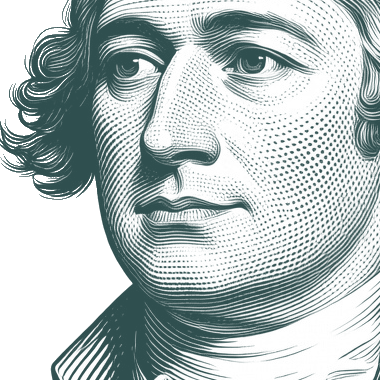
Who talks most about freedom and equality? Is it not those who hold the bill of rights in one hand and a whip for affrighted slaves in the other? - Alexander Hamilton
""
Who talks most about freedom and equality? Is it not those who hold the bill of rights in one hand and a whip for affrighted slaves in the other?
Alexander Hamilton (11 January 1755 or 1757 – 12 July 1804) was a Founding Father of the United States, chief staff aide to General George Washington, one of the most influential interpreters and promoters of the U.S. Constitution, the founder of the nation's financial system, the founder of the Federalist Party, the world's first voter-based political party, the Father of the United States Coast Guard, and the founder of The New York Post.
Biography information from
Wikiquote·
Portrait adapted from
Wikimedia Commons, John Trumbull (Public domain / CC0)
Also Known As
Pen Names:
Publius
Alternative Names:
Hamilton
•
Alexander Hamilton, US Treasury secretary
•
A. Ham
In no part of the constitution is more wisdom to be found than in the clause which confides the question of war or peace to the legislature, and not to the executive department. Beside the objection to such a mixture of heterogeneous powers: the trust and the temptation would be too great for any one man: not such as nature may offer as the prodigy of many centuries, but such as may be expected in the ordinary successions of magistracy. War is in fact the true nurse of executive aggrandizement. In war a physical force is to be created, and it is the executive will which is to direct it. In war the public treasures are to be unlocked, and it is the executive hand which is to dispense them. In war the honors and emoluments of office are to be multiplied; and it is the executive patronage under which they are to be enjoyed. It is in war, finally, that laurels are to be gathered, and it is the executive brow they are to encircle. The strongest passions, and most dangerous weaknesses of the human breast; ambition, avarice, vanity, the honorable or venial love of fame, are all in conspiracy against the desire and duty of peace.
If then the Courts of justice are to be considered as the bulwarks of a limited Constitution, against Legislative encroachments, this consideration will afford a strong argument for the permanent tenure of Judicial offices, since nothing will contribute so much as this to that independent spirit in the Judges, which must be essential to the faithful performance of so arduous a duty. This independence of the Judges is equally requisite to guard the Constitution and the rights of individuals, from the effects of those ill humors, which the arts of designing men, or the influence of particular conjunctures, sometimes disseminate among the People themselves, and which, though they speedily give place to better information, and more deliberate reflection, have a tendency, in the mean time, to occasion dangerous innovations in the Government, and serious oppressions of the minor party in the community.
Enhance Your Quote Experience
Enjoy ad-free browsing, unlimited collections, and advanced search features with Premium.