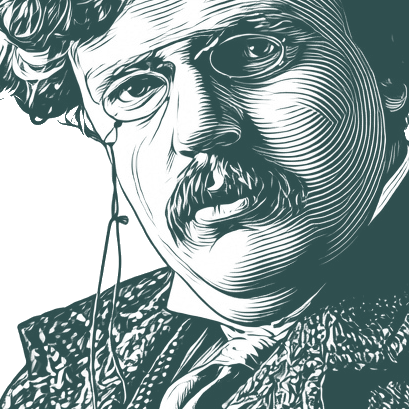
Gilbert Keith Chesterton (29 May 1874 – 14 June 1936) was a British writer whose prolific and diverse output included works of philosophy, ontology, poetry, play writing, journalism, public lecturing and debating, literary and art criticism, biography, Christian apologetics (particularly for Catholicism), and fiction, including fantasy and detective fiction. He has been called the "prince of paradox".
Biography information from
Wikiquote·
Portrait adapted from
Wikimedia Commons, Ernest Herbert Mills (Public domain / CC0)
Also Known As
Native Name:
Gilbert Keith Chesterton
Alternative Names:
František Kafka
•
Kafka
•
Gilbert K. Chesterton
•
Gilbert Chesterton
•
G.K. Chesterton
•
G. K. C.
'I'm afraid I'm a practical man,' said the doctor with gruff humour, 'and I don't bother much about religion and philosophy.' 'You'll never be a practical man till you do,' said Father Brown. 'Look here, doctor; you know me pretty well; I think you know I'm not a bigot. You know I know there are all sorts in all religions; good men in bad ones and bad men in good ones.
There is not really any courage at all in attacking hoary or antiquated things, any more than in offering to fight one’s grandmother. The really courageous man is he who defies tyrannies young as the morning and superstitions fresh as the first flowers. The only true free-thinker is he whose intellect is as much free from the future as from the past.
Works in ChatGPT, Claude, or Any AI
Add semantic quote search to your AI assistant via MCP. One command setup.