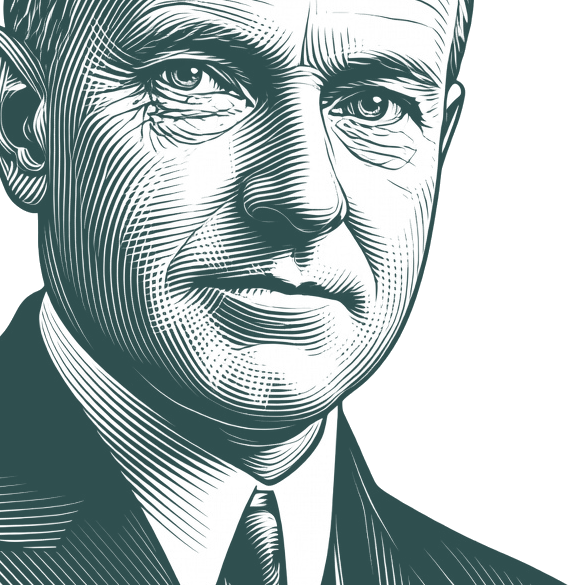
It is axiomatic that our country can not stand still. It would seem to be perfectly plain from recent events that it is determined to go forward. But… - Calvin Coolidge
""
It is axiomatic that our country can not stand still. It would seem to be perfectly plain from recent events that it is determined to go forward. But it wants no pretenses, it wants no vagaries. It is determined to advance in an orderly, sound and common-sense way. It does not propose to abandon the theory of the Declaration that the people have inalienable rights which no majority and no power of government can destroy. It does not propose to abandon the practice of the Constitution that provides for the protection of these rights. It believes that within these limitations, which are imposed not by the fiat of man but by the law of the Creator, self-government is just and wise. It is convinced that it will be impossible for the people to provide their own government unless they continue to own their own property. These are the very foundations of America. On them has been erected a Government of freedom and equality, of justice and mercy, of education and charity. Living under it and supporting it the people have come into great possessions on the material and spiritual sides of life. I want to continue in this direction. I know that the Congress shares with me that desire. I want our institutions to be more and more expressive of these principles. I want the people of all the earth to see in the American flag the symbol of a Government which intends no oppression at home and no aggression abroad, which in the spirit of a common brotherhood provides assistance in time of distress.
John Calvin Coolidge Jr. (4 July 1872 – 5 January 1933) was the 30th president of the United States (1923–29). A Republican lawyer from Vermont, Coolidge worked his way up the ladder of Massachusetts state politics, eventually becoming governor of that state. His response to the Boston Police Strike of 1919 thrust him into the national spotlight and gave him a reputation as a man of decisive action. Soon after, he was elected as the 29th vice president in 1920 and succeeded to the presidency upon the sudden death of Warren G. Harding in 1923. Elected in his own right in 1924, he gained a reputation as a small-government conservative.
Biography information from
Wikiquote·
Portrait adapted from
Wikimedia Commons, Harris & Ewing (Public domain / CC0)
Also Known As
Birth Name:
John Calvin
Alternative Names:
John Calvin Coolidge Jr.
•
John Calvin Coolidge
•
President Coolidge
•
J. C. Coolidge
•
C. Coolidge
•
Silent Cal
•
Silent Cal Coolidge
It is equally clear that a government must govern, must prescribe and enforce laws within its sphere or cease to be a government. Moreover, the individual must be independent and free within his own sphere or cease to be an individual. The fundamental question was then, is now, and always will be through what adjustments, by what actions, these principles may be applied.
That power and that authority has to reside somewhere in every government. Originally it lay with the king. After limitations began to be placed upon him, it was conferred upon the parliamentary body. One of the great contributions which America made to the science of government was the establishment of an independent judiciary department under which this authority resides in the Supreme Court. That tribunal has been made as independent and impartial as human nature could devise. This action was taken with the sole purpose of protecting the freedom of the individual, of guarding his earnings, his home, his life.
Go Premium
Support Quotewise while enjoying an ad-free experience and premium features.
We revere that day because it marks the beginnings of independence, the beginnings of a constitution that was finally to give universal freedom and equality to all American citizens — the beginnings of a government that was to recognize beyond all others the power and worth and dignity of man. There began the first of governments to acknowledge that it was founded on the sovereignty of the people. There the world first beheld the revelation of modern democracy.