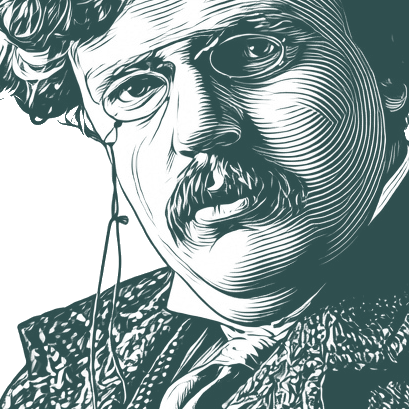
Surely we cannot take an open question like the supernatural and shut it with a bang, turning the key of the madhouse on all the mystics of history. … - G. K. Chesterton
""
Surely we cannot take an open question like the supernatural and shut it with a bang, turning the key of the madhouse on all the mystics of history. You cannot take the region of the unknown and calmly say that, though you know nothing about it, you know all the gates are locked. We do not know enough about the unknown to know that it is unknowable.
Gilbert Keith Chesterton (29 May 1874 – 14 June 1936) was a British writer whose prolific and diverse output included works of philosophy, ontology, poetry, play writing, journalism, public lecturing and debating, literary and art criticism, biography, Christian apologetics (particularly for Catholicism), and fiction, including fantasy and detective fiction. He has been called the "prince of paradox".
Biography information from
Wikiquote·
Portrait adapted from
Wikimedia Commons, Ernest Herbert Mills (Public domain / CC0)
Also Known As
Native Name:
Gilbert Keith Chesterton
Alternative Names:
František Kafka
•
Kafka
•
Gilbert K. Chesterton
•
Gilbert Chesterton
•
G.K. Chesterton
•
G. K. C.
I tell you naught for your comfort, Yea, naught for your desire, Save that the sky grows darker yet And the sea rises higher.
The thing that really is trying to tyrannize through government is Science. The thing that really does use the secular arm is Science. And the creed that really is levying tithes and capturing schools, the creed that really is enforced by fine and imprisonment, the creed that really is proclaimed not in sermons but in statutes, and spread not by pilgrims but by policemen – that creed is the great but disputed system of thought which began with Evolution and has ended in Eugenics. Materialism is really our established Church; for the Government will really help it to persecute its heretics.
Go Premium
Support Quotewise while enjoying an ad-free experience and premium features.
I mean that we here are on the wrong side of the tapestry,' answered Father Brown. 'The things that happen here do not seem to mean anything; they mean something somewhere else. Somewhere else retribution will come on the real offender. Here it often seems to fall on the wrong person.