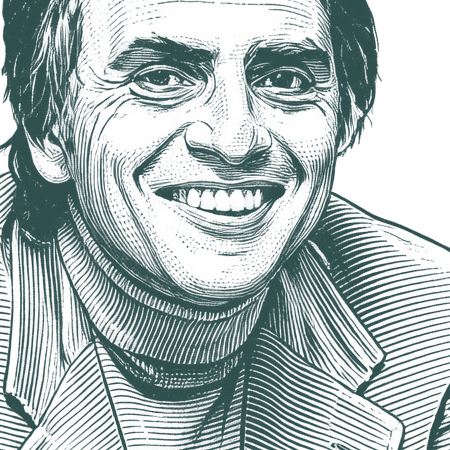
Tides of people will continue to ebb and flow across the planet. But the lands we run to now have already been settled. Other people, often unsympath… - Carl Sagan
""
Tides of people will continue to ebb and flow across the planet. But the lands we run to now have already been settled. Other people, often unsympathetic to our plight, are there before us.
Carl Edward Sagan (9 November 1934 – 20 December 1996) was an American astronomer, planetary scientist, cosmologist, astrophysicist, astrobiologist, author, and science communicator. His best known scientific contribution is research on extraterrestrial life, including experimental demonstration of the production of amino acids from basic chemicals by radiation. Sagan assembled the first physical messages sent into space, the Pioneer plaque and the Voyager Golden Record, universal messages that could potentially be understood by any extraterrestrial intelligence that might find them. Sagan argued the hypothesis, accepted since, that the high surface temperatures of Venus can be attributed to, and calculated using, the greenhouse effect. He testified to the US Congress in 1985 that the greenhouse effect will change the earth's climate system.
Biography information from
Wikiquote·
Portrait adapted from
Wikimedia Commons, NASA/JPL (Public domain / CC0)
Also Known As
Native Name:
Carl Edward Sagan
Alternative Names:
Sagan
•
Carl E. Sagan
•
Carl E Sagan
•
C. E. Sagan
•
C.E. Sagan
•
C E Sagan
•
C. Sagan
•
C Sagan
•
Sagan C
•
Sagan C.
•
Sagan C. E.
•
Sagan CE
I know of no significant advance in science that did not require major inputs from both cerebral hemispheres. This is not true for art, where apparently there are no experiments by which capable, dedicated and unbiased observers can determine to their mutual satisfaction which works are great.
I maintain there is much more wonder in science than in pseudoscience. And in addition, to whatever measure this term has any meaning, science has the additional virtue, and it is not an inconsiderable one, of being true.
Enhance Your Quote Experience
Enjoy ad-free browsing, unlimited collections, and advanced search features with Premium.
Clearly there are limits to the uses of skepticism. There is some cost-benefit analysis which must be applied, and if the comfort, consolation and hope delivered by mysticism and superstition is high, and the dangers of belief comparatively low, should we not keep our misgivings to ourselves? But the issue is tricky. Imagine that you enter a big-city taxicab and the moment you get settled in, the driver begins a harangue about the supposed iniquities and inferiorities of another ethnic group. Is your best course to keep quiet, bearing in mind that silence conveys assent? Or is it your moral responsibility to argue with him, to express outrage, even to leave the cab — because you know that every silent assent will encourage him next time, and every vigorous dissent will cause him next time to think twice? Likewise, if we offer too much silent assent about mysticism and superstition — even when it seems to be doing a little good — we abet a general climate in which skepticism is considered impolite, science tiresome, and rigorous thinking somehow stuffy and inappropriate. Figuring out a prudent balance takes wisdom.