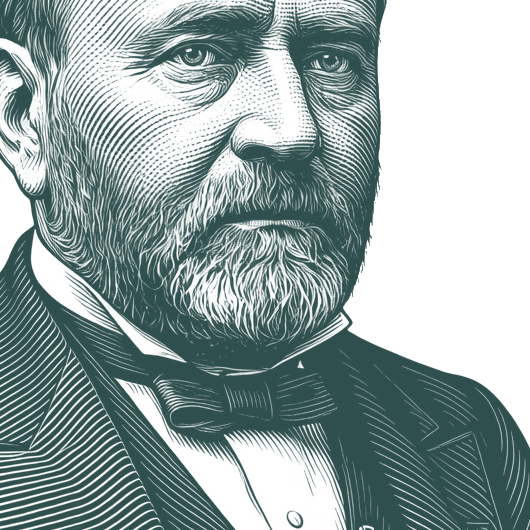
You must take it; I cannot live with anything in my possession that is not mine. - Ulysses S. Grant
""
You must take it; I cannot live with anything in my possession that is not mine.
English
Collect this quote
About
Ulysses S. Grant
Ulysses S. Grant (27 April 1822 – 23 July 1885), born as Hiram Ulysses Grant, was the 18th president of the United States of America, from 1869 to 1877. As the Commanding General of the U.S. Army, Grant worked closely with U.S. President Abraham Lincoln to lead the U.S. Army to victory over the Confederacy in the American Civil War. He implemented Congressional Reconstruction, often at odds with Lincoln's successor, Andrew Johnson. Twice elected to the presidency, Grant led the Republicans in their effort to remove the vestiges of Confederate nationalism and slavery, protect the citizenship of African-Americans, and support U.S. economic prosperity.
Biography information from
Wikiquote·
Portrait adapted from
Wikimedia Commons, Brady-Handy Photograph Collection, Library of Congress (Public domain / CC0)
Also Known As
Birth Name:
Hiram Ulysses Grant
Also Known As:“Unconditional Surrender” Grant
Alternative Names:
General Grant
•
Ulysses Hiram Grant
•
Ulysses Grant
•
Ulysses S Grant
•
President Grant
•
U. S. Grant
•
U.S. Grant
•
Ulysses Simpson Grant
Portrait from Wikimedia Commons. Credit: Brady-Handy Photograph Collection, Library of Congress. Used under Public domain / CC0. Processed and styled by Quotewise.
Enhance Your Quote Experience
Enjoy ad-free browsing, unlimited collections, and advanced search features with Premium.
There were churches in that part of Ohio where treason was preached regularly, and where, to secure membership, hostility to the government, to the war and to the liberation of the slaves, was far more essential than a belief in the authenticity or credibility of the Bible. There were men in Georgetown who filled all the requirements for membership in these churches.
There would be no import duties upon the supplies, machinery, etc., going from the States. The effect that would have been produced upon Cuban commerce, with these advantages to a rival, is observable at a glance. The Cuban question would have been settled long ago in favor of "free Cuba." Hundreds of American vessels would now be advantageously used in transporting the valuable woods and other products of the soil of the island to a market and in carrying supplies and emigrants to it. The island is but sparsely settled, while it has an area sufficient for the profitable employment of several millions of people.
From that age until seventeen I did all the work done with horses, such as breaking up the land, furrowing, ploughing corn and potatoes, bringing in the crops when harvested, hauling all the wood, besides tending two or three horses, a cow or two, and sawing wood for stoves, etc., while still attending school. For this I was compensated by the fact that there was never any scolding or punishing by my parents; no objection to rational enjoyments, such as fishing, going to the creek a mile away to swim in summer, taking a horse and visiting my grandparents in the adjoining county, fifteen miles off, skating on the ice in winter, or taking a horse and sleigh when there was snow on the ground. While still quite young I had visited Cincinnati, forty-five miles away, several times, alone; also Maysville, Kentucky, often, and once Louisville. The journey to Louisville was a big one for a boy of that day. I had also gone once with a two-horse carriage to Chilicothe, about seventy miles, with a neighbor’s family, who were removing to Toledo, Ohio, and returned alone; and had gone once, in like manner, to Flat Rock, Kentucky, about seventy miles away. On this latter occasion I was fifteen years of age.