I can only look from the outside (or cut into the inside, but flesh and genes do not reveal organic totality). I am stuck with a panoply of ineluctab… - Stephen Jay Gould
""
I can only look from the outside (or cut into the inside, but flesh and genes do not reveal organic totality). I am stuck with a panoply of ineluctably indirect methods - some very sophisticated to be sure. I can atomize, experiment, and infer. I can record reams of data about behaviors and responses. But if I could be a beetle or a bacillus for that one precious minute - and live to tell the tale in perfect memory - then I might truly fulfill Darwin's dictum penned into an early notebook containing the first full flowering of his evolutionary ideas during the late 1830's: "He who understands the baboon would do more towards metaphysics than Locke."
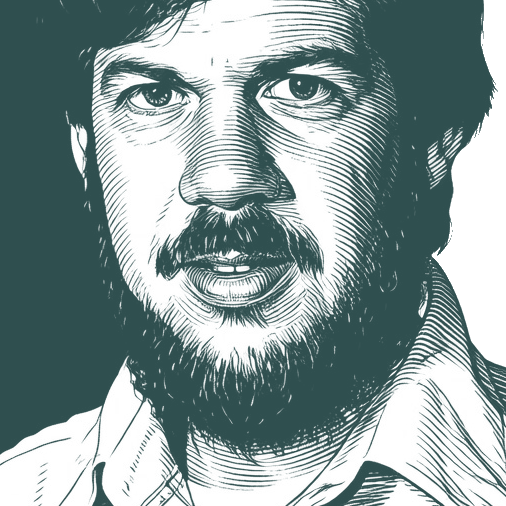
Stephen Jay Gould (September 10, 1941 – May 20, 2002) was an American geologist, paleontologist, evolutionary biologist and popular-science author, who spent most of his career teaching at Harvard University and working at the American Museum of Natural History in New York. He was one of the most influential and widely read writers of popular science of his generation.
Biography information from
Wikiquote·
Portrait adapted from
Wikimedia Commons, Lawrence Lipke (Public domain / CC0)
A proper theory of morality depends upon the separation of intentions from results.
Throughout his last half-dozen books, for example, Arthur Koestler has been conducting a campaign against his own misunderstanding of Darwinism. He hopes to find some ordering force, constraining evolution to certain directions and overriding the influence of natural selection. […] Darwinism is not the theory of capricious change that Koestler imagines. Random variation may be the raw material of change, but natural selection builds good design by rejecting most variants while accepting and accumulating the few that improve adaptation to local environments.
The facts of nature are what they are, but we can only view them through the spectacles of our mind. Our mind works largely by metaphor and comparison, not always (or often) by relentless logic. When we are caught in conceptual traps, the best exit is often a change in metaphor — not because the new guideline will be truer to nature (for neither the old nor the new metaphor lies “out there” in the woods), but because we need a shift to more fruitful perspectives, and metaphor is often the best agent of conceptual transition.