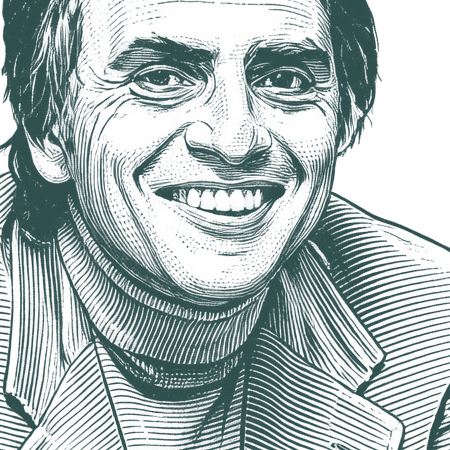
Carl Edward Sagan (9 November 1934 – 20 December 1996) was an American astronomer, planetary scientist, cosmologist, astrophysicist, astrobiologist, author, and science communicator. His best known scientific contribution is research on extraterrestrial life, including experimental demonstration of the production of amino acids from basic chemicals by radiation. Sagan assembled the first physical messages sent into space, the Pioneer plaque and the Voyager Golden Record, universal messages that could potentially be understood by any extraterrestrial intelligence that might find them. Sagan argued the hypothesis, accepted since, that the high surface temperatures of Venus can be attributed to, and calculated using, the greenhouse effect. He testified to the US Congress in 1985 that the greenhouse effect will change the earth's climate system.
Biography information from
Wikiquote·
Portrait adapted from
Wikimedia Commons, NASA/JPL (Public domain / CC0)
Also Known As
Native Name:
Carl Edward Sagan
Alternative Names:
Sagan
•
Carl E. Sagan
•
Carl E Sagan
•
C. E. Sagan
•
C.E. Sagan
•
C E Sagan
•
C. Sagan
•
C Sagan
•
Sagan C
•
Sagan C.
•
Sagan C. E.
•
Sagan CE
أكثر الاكتشافات إثارة للدهشة ستكون تلك التي لانملك الآن مايكفي من الذكاء لتوقعها
El escepticismo tiene por función ser peligroso. Es un desafío a las instituciones establecidas. Si enseñamos a todo el mundo, incluyendo por ejemplo a los estudiantes de educación secundaria, unos hábitos de pensamiento escéptico, probablemente no limitarán su escepticismo a los ovnis, los anuncios de aspirinas y los profetas canalizados de 35.000 años. Quizá empezarán a hacer preguntas importantes sobre las instituciones económicas, sociales, políticas o religiosas. Quizá desafiarán las opiniones de los que están en el poder. ¿Dónde estaremos entonces?
Pseudoscience is easier to contrive than science, because distracting confrontations with reality — where we cannot control the outcome of the comparison — are more readily avoided. The standards of argument, what passes for evidence, are much more relaxed. In part for these same reasons, it is much easier to present pseudoscience to the general public than science. But this isn’t enough to explain its popularity.