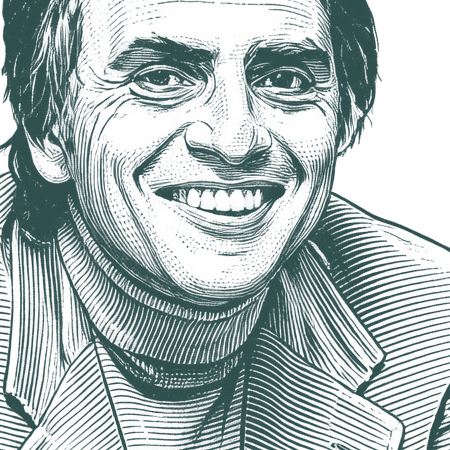
As a boy Kepler had been captured by a vision of cosmic splendour, a harmony of the worlds which he sought so tirelessly all his life. Harmony in thi… - Carl Sagan
""
As a boy Kepler had been captured by a vision of cosmic splendour, a harmony of the worlds which he sought so tirelessly all his life. Harmony in this world eluded him. His three laws of planetary motion represent, we now know, a real harmony of the worlds, but to Kepler they were only incidental to his quest for a cosmic system based on the Perfect Solids, a system which, it turns out, existed only in his mind. Yet from his work, we have found that scientific laws pervade all of nature, that the same rules apply on Earth as in the skies, that we can find a resonance, a harmony, between the way we think and the way the world works. When he found that his long cherished beliefs did not agree with the most precise observations, he accepted the uncomfortable facts, he preferred the hard truth to his dearest illusions. That is the heart of science.
English
Collect this quote
About
Carl Sagan
Carl Edward Sagan (9 November 1934 – 20 December 1996) was an American astronomer, planetary scientist, cosmologist, astrophysicist, astrobiologist, author, and science communicator. His best known scientific contribution is research on extraterrestrial life, including experimental demonstration of the production of amino acids from basic chemicals by radiation. Sagan assembled the first physical messages sent into space, the Pioneer plaque and the Voyager Golden Record, universal messages that could potentially be understood by any extraterrestrial intelligence that might find them. Sagan argued the hypothesis, accepted since, that the high surface temperatures of Venus can be attributed to, and calculated using, the greenhouse effect. He testified to the US Congress in 1985 that the greenhouse effect will change the earth's climate system.
Biography information from
Wikiquote·
Portrait adapted from
Wikimedia Commons, NASA/JPL (Public domain / CC0)
Also Known As
Native Name:
Carl Edward Sagan
Alternative Names:
Sagan
•
Carl E. Sagan
•
Carl E Sagan
•
C. E. Sagan
•
C.E. Sagan
•
C E Sagan
•
C. Sagan
•
C Sagan
•
Sagan C
•
Sagan C.
•
Sagan C. E.
•
Sagan CE
Our intelligence and our technology have given us the power to affect the climate. How will we use this power? Are we willing to tolerate ignorance and complacency in matters that affect the entire human family? Do we value short-term advantages above the welfare of the Earth? Or will we think on longer time scales, with concern for our children and our grandchildren, to understand and protect the complex life-support systems of our planet? The Earth is a tiny and fragile world. It needs to be cherished.
Our posturings, our imagined self-importance, the delusion that we have some privileged position in the Universe, are challenged (...) Our planet is a lonely speck in the great enveloping cosmic dark. In our obscurity, in all this vastness, there is no hint that help will come from elsewhere to save us from ourselves.
Try QuoteGPT
Chat naturally about what you need. Each answer links back to real quotes with citations.
It is called Giordano Bruno after the sixteenth-century Roman Catholic scholar who held that there are an infinity of worlds and that many are inhabited. For this and other crimes he was burned at the stake in the year 1600.