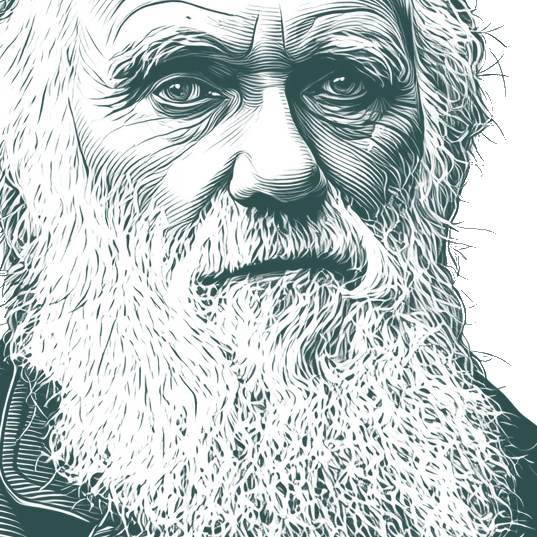
Charles Robert Darwin (12 February 1809 – 19 April 1882) was an English naturalist, geologist and biologist, best known for his contributions to the science of evolution. He proposed that evolution could be explained in part through natural and sexual selection. Prompted by awareness that Alfred Russel Wallace was developing similar theories he published his own sooner than he had originally intended. This theory is now an integral component of biological science.
Biography information from
Wikiquote·
Portrait adapted from
Wikimedia Commons, Herbert Rose Barraud (Public domain / CC0)
Also Known As
Birth Name:
Charles Robert Darwin
Alternative Names:
Charles R. Darwin
•
C. R. Darwin
•
Darwin
•
C.R. Darwin
•
CR Darwin
In October 1838, that is, fifteen months after I had begun my systematic enquiry, I happened to read for amusement 'Malthus on Population,' and being well prepared to appreciate the struggle for existence which everywhere goes on from long-continued observation of the habits of animals and plants, it at once struck me that under these circumstances favourable variations would tend to be preserved, and unfavourable ones to be destroyed. The result of this would be the formation of new species. Here then I had at last got a theory by which to work; but I was so anxious to avoid prejudice, that I determined not for some time to write even the briefest sketch of it. In June 1842 I first allowed myself the satisfaction of writing a very brief abstract of my theory in pencil in 35 pages; and this was enlarged during the summer of 1844 into one of 230 pages...
But I was very unwilling to give up my belief; I feel sure of this, for I can well remember often and often inventing day-dreams of old letters between distinguished Romans, and manuscripts being discovered at Pompeii or elsewhere, which confirmed in the most striking manner all that was written in the Gospels. But I found it more and more difficult, with free scope given to my imagination, to invent evidence which would suffice to convince me. Thus disbelief crept over me at a very slow rate, but was at last complete. The rate was so slow that I felt no distress. Although I did not think much about the existence of a personal God until a considerably later period of my life, I will here give the vague conclusions to which I have been driven. The old argument from design in Nature, as given by Paley, which formerly seemed to me so conclusive, fails, now that the law of natural selection has been discovered. We can no longer argue that, for instance, the beautiful hinge of a bivalve shell must have been made by an intelligent being, like the hinge of a door by man. There seems to be no more design in the variability of organic beings, and in the action of natural selection, than in the course which the wind blows. But I have discussed this subject at the end of my book on the Variation of Domesticated Animals and Plants, and the argument there given has never, as far as I can see, been answered.
Try QuoteGPT
Chat naturally about what you need. Each answer links back to real quotes with citations.
It will be seen that I look at the term species, as one arbitrarily given for the sake of convenience to a set of individuals closely resembling each other, and that it does not essentially differ from the term variety, which is given to less distinct and more fluctuating forms. The term variety, again, in comparison with mere individual differences, is also applied arbitrarily, and for mere convenience sake.