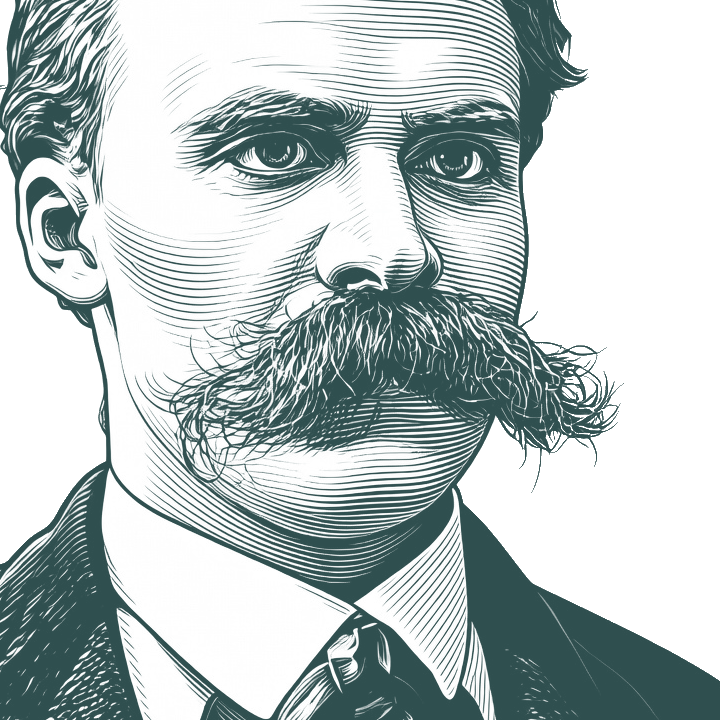
Friedrich Wilhelm Nietzsche (15 October 1844 – 25 August 1900) was a German philosopher, cultural critic, composer, poet, writer, and philologist whose work has exerted a profound influence on modern intellectual history. His critiques of contemporary culture, religion, and philosophy centered on a basic question regarding the foundation of values and morality.
Biography information from
Wikiquote·
Portrait adapted from
Wikimedia Commons, Friedrich Hermann Hartmann (Public domain / CC0)
Also Known As
Alternative Names:
Friedrich Wilhelm Nietzsche
•
Nietzsche
The liar is a person who uses the valid designations, the words, in order to make something which is unreal appear to be real. He says, for example, "I am rich," when the proper designation for his condition would be "poor." He misuses fixed conventions by means of arbitrary substitutions or even reversals of names. If he does this in a selfish and moreover harmful manner, society will cease to trust him and will thereby exclude him. What men avoid by excluding the liar is not so much being defrauded as it is being harmed by means of fraud. Thus, even at this stage, what they hate is basically not deception itself, but rather the unpleasant, hated consequences of certain sorts of deception. It is in a similarly restricted sense that man now wants nothing but truth: he desires the pleasant, life-preserving consequences of truth. He is indifferent toward pure knowledge which has no consequences; toward those truths which are possibly harmful and destructive he is even hostilely inclined.
Psychology has falsified love as surrender and altruism, while it is an appropriation or a bestowal following from a super-abundance of personality. Only the most complete persons can love. The depersonalized and objective are the worst lovers.
Go Premium
Support Quotewise while enjoying an ad-free experience and premium features.
It is said with good reason that convictions have no civic rights in the domain of science: it is only when a 277conviction voluntarily condescends to the modesty of an hypothesis, a preliminary standpoint for experiment, or a regulative fiction, that its access to the realm of knowledge, and a certain value therein, can be conceded,—always, however, with the restriction that it must remain under police supervision, under the police of our distrust.—Regarded more accurately, however, does not this imply that only when a conviction ceases to be a conviction can it obtain admission into science? Does not the discipline of the scientific spirit just commence when one no longer harbours any conviction?... It is probably so: only, it remains to be asked whether, in order that this discipline may commence, it is not necessary that there should already be a conviction, and in fact one so imperative and absolute, that it makes a sacrifice of all other convictions. One sees that science also rests on a belief: there is no science at all "without premises." The question whether truth is necessary, must not merely be affirmed beforehand, but must be affirmed to such an extent that the principle, belief, or conviction finds expression, that "there is nothing more necessary than truth, and in comparison with it everything else has only a secondary value."—This absolute will to truth: what is it? Is it the will not to allow ourselves to be deceived?