Reduced to their most pregnant difference, empiricism means the habit of explaining wholes by parts, and rationalism means the habit of explaining pa… - William James
""
Reduced to their most pregnant difference, empiricism means the habit of explaining wholes by parts, and rationalism means the habit of explaining parts by wholes. Rationalism thus preserves affinities with monism, since wholeness goes with union, while empiricism inclines to pluralistic views. No philosophy can ever be anything but a summary sketch, a picture of the world in abridgment, a foreshortened bird's-eye view of the perspective of events. And the first thing to notice is this, that the only material we have at our disposal for making a picture of the whole world is supplied by the various portions of that world of which we have already had experience. We can invent no new forms of conception, applicable to the whole exclusively, and not suggested originally by the parts. All philosophers, accordingly, have conceived of the whole world after the analogy of some particular feature of it which has particularly captivated their attention. Thus, the theists take their cue from manufacture, the pantheists from growth. For one man, the world is like a thought or a grammatical sentence in which a thought is expressed. For such a philosopher, the whole must logically be prior to the parts; for letters would never have been invented without syllables to spell, or syllables without words to utter. Another man, struck by the disconnectedness and mutual accidentality of so many of the world's details, takes the universe as a whole to have been such a disconnectedness originally, and supposes order to have been superinduced upon it in the second instance, possibly by attrition and the gradual wearing away by internal friction of portions that originally interfered. Another will conceive the order as only a statistical appearance, and the universe will be for him like a vast grab-bag with black and white balls in it, of which we guess the quantities only probably, by the frequency with which we experience their egress. For another, again, there is no really inherent order, but it is we who project order into the world by selecting objects and tracing relations so as to gratify our intellectual interests. We carve out order by leaving the disorderly parts out; and the world is conceived thus after the analogy of a forest or a block of marble from which parks or statues may be produced by eliminating irrelevant trees or chips of stone. Some thinkers follow suggestions from human life, and treat the universe as if it were essentially a place in which ideals are realized. Others are more struck by its lower features, and for them, brute necessities express its character better. All follow one analogy or another; and all the analogies are with some one or other of the universe's subdivisions. Every one is nevertheless prone to claim that his conclusions are the only logical ones, that they are necessities of universal reason, they being all the while, at bottom, accidents more or less of personal vision which had far better be avowed as such; for one man's vision may be much more valuable than another's, and our visions are usually not only our most interesting but our most respectable contributions to the world in which we play our part. What was reason given to men for, said some eighteenth century writer, except to enable them to find reasons for what they want to think and do?—and I think the history of philosophy largely bears him out, "The aim of knowledge," says Hegel, "is to divest the objective world of its strangeness, and to make us more at home in it." Different men find their minds more at home in very different fragments of the world.
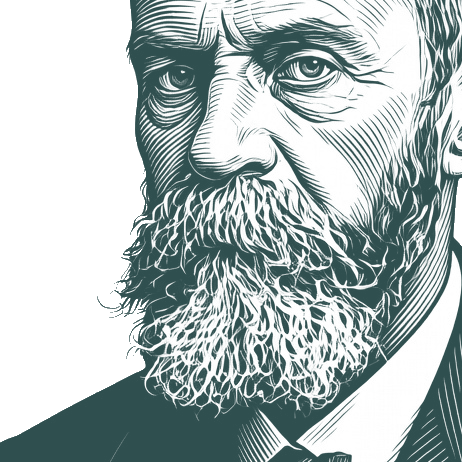
William James (11 January 1842 – 26 August 1910) was a pioneering American psychologist and philosopher. He developed the philosophical perspective known as radical empiricism, and wrote influential books on the science of psychology, the psychology of religious experience and mysticism, and the philosophy of pragmatism.
Biography information from
Wikiquote·
Portrait adapted from
Wikimedia Commons, Alice Boughton (Public domain / CC0)
The more rational statement is that we feel sorry because we cry, angry because we strike, afraid because we tremble, and not that we cry, strike, or tremble, because we are sorry, angry, or fearful, as the case may be. Without the bodily states following on the perception, the latter would be purely cognitive in form, pale, colorless, destitute of emotional warmth.
If you can change your mind, you can change your life.
Limited Time Offer
Premium members can get their quote collection automatically imported into their Quotewise collections.
It would probably astound each of us beyond measure to be let into his neighbors mind and to find how different the scenery was there from that of his own.