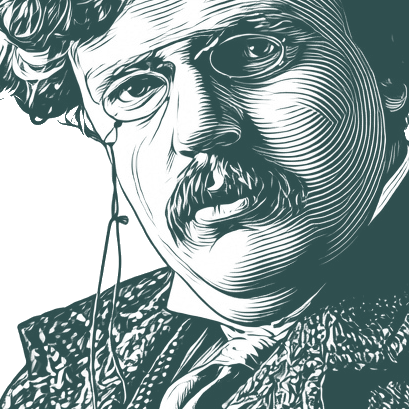
We are in this fairyland on sufferance; it is not for us to quarrel with the conditions under which we enjoy this wild vision of the world. - G. K. Chesterton
""
We are in this fairyland on sufferance; it is not for us to quarrel with the conditions under which we enjoy this wild vision of the world.
Gilbert Keith Chesterton (29 May 1874 – 14 June 1936) was a British writer whose prolific and diverse output included works of philosophy, ontology, poetry, play writing, journalism, public lecturing and debating, literary and art criticism, biography, Christian apologetics (particularly for Catholicism), and fiction, including fantasy and detective fiction. He has been called the "prince of paradox".
Biography information from
Wikiquote·
Portrait adapted from
Wikimedia Commons, Ernest Herbert Mills (Public domain / CC0)
Also Known As
Native Name:
Gilbert Keith Chesterton
Alternative Names:
František Kafka
•
Kafka
•
Gilbert K. Chesterton
•
Gilbert Chesterton
•
G.K. Chesterton
•
G. K. C.
"Your offer," he said, "is far too idiotic to be declined."
The journalists would appear to be in an almost literal sense the priests of the modern world. They may not rise precisely to the tremendous responsibility which was laid upon Peter, but at least it can be said that whatever they bind on earth is bound on earth, and whatever they loose on earth is loosed on earth. They have essentially and absolutely the same functions that were employed by the old priests, but their power for deceit is even greater and their responsibility to the world even less. A comparison between the priests and the journalists would be striking in many points. [...] The priest's influence and power consisted almost entirely in the fact that he was the only man who brought news. [...] the corruption of the priesthood occurred at the precise moment in which it changed from a minority organised to impart knowledge into a minority organised to withhold it. The great danger of decadence in journalism is almost exactly the same. Journalism possesses in itself the potentiality of becoming one of the most frightful monstrosities and delusions that have ever cursed mankind. This horrible transformation will occur at the exact instant at which journalists realise that they can become an aristocracy.
Unlimited Quote Collections
Organize your favorite quotes without limits. Create themed collections for every occasion with Premium.
Mysticism keeps men sane. As long as you have mystery you have health; when you destroy mystery you create morbidity. The ordinary man has always been sane because the ordinary man has always been a mystic. He has permitted the twilight. He has always had one foot in earth and the other in fairyland. He has always left himself free to doubt his gods; but (unlike the agnostic of to-day) free also to believe in them. He has always cared more for truth than for consistency. If he saw two truths that seemed to contradict each other, he would take the two truths and contradiction along with them. His spiritual sight is stereoscopic, like his physical sight: he sees two different pictures at once and yet sees all the better for that. Thus, he has always believed that there was such a thing as fate, but such a thing as free will also. Thus, he believes that children were indeed the kingdom of heaven, but nevertheless ought to be obedient to the kingdom of earth. He admired youth because it was young and age because it was not. It is exactly this balance of apparent contradictions that has been the whole buoyancy of the healthy man. The whole secret of mysticism is this: that man can understand everything by the help of what he does not understand. The morbid logician seeks to make everything lucid, and succeeds in making everything mysterious. The mystic allows one thing to be mysterious, and everything else becomes lucid.