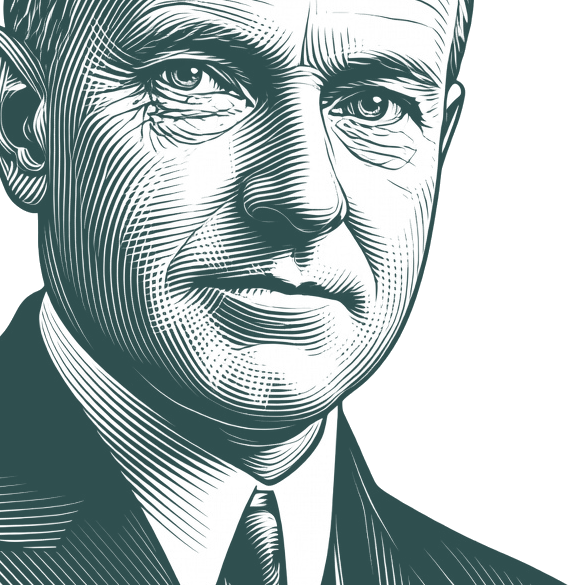
For, primarily, the immigrant comes here for economic reasons. If he is a dependent, there is no room for him. If he believes that in America one nee… - Calvin Coolidge
""
For, primarily, the immigrant comes here for economic reasons. If he is a dependent, there is no room for him. If he believes that in America one need not work, there is no room for him. If he has been taught that his labor is a commodity for sale, he must learn that labor is no more a commodity than management. It is the product of labor, the product of management, that is put up for sale. In the last analysis, it is man's intelligence that is purchased. Only in undeveloped countries can man be regarded as a beast of burden.
John Calvin Coolidge Jr. (4 July 1872 – 5 January 1933) was the 30th president of the United States (1923–29). A Republican lawyer from Vermont, Coolidge worked his way up the ladder of Massachusetts state politics, eventually becoming governor of that state. His response to the Boston Police Strike of 1919 thrust him into the national spotlight and gave him a reputation as a man of decisive action. Soon after, he was elected as the 29th vice president in 1920 and succeeded to the presidency upon the sudden death of Warren G. Harding in 1923. Elected in his own right in 1924, he gained a reputation as a small-government conservative.
Biography information from
Wikiquote·
Portrait adapted from
Wikimedia Commons, Harris & Ewing (Public domain / CC0)
Also Known As
Birth Name:
John Calvin
Alternative Names:
John Calvin Coolidge Jr.
•
John Calvin Coolidge
•
President Coolidge
•
J. C. Coolidge
•
C. Coolidge
•
Silent Cal
•
Silent Cal Coolidge
As these old soldiers, the living descendants of the spirit of Washington that made our country, go down toward the setting sun, representing the spirit of Lincoln, who saved our country, they will have the satisfaction of knowing that they are leaving behind them the same spirit, still undaunted, still ready to maintain in the future a more abiding peace and a more abounding prosperity, under which America can continue to work for the salvation of the world.
In these days little need exists for extolling the blessings of our Federal Union. Its benefits are known and recognized by all its citizens who are worthy of serious attention. No one thinks now of attempting to destroy the Union by armed force. No one seriously considers withdrawing from it. But it is not enough that it should be free from attack — it must be approved and supported by a national spirit. Our prime allegiance must be to the whole country. A sentiment of sectionalism is not harmless because it is unarmed. Resistance to the righteous authority of Federal law is not innocent because it is not accompanied by secession. We need a more definite realization that all of our country must stand or fall together, and that it is the duty of the Government to promote the welfare of each part and the duty of the citizen to remember that he must be first of all an American.
The laws of supply and demand, therefore, are adjuncts to immigration regulation. I do not fear the arrival of as many immigrants a year as shipping conditions or passport requirements can handle, provided they are of good character. But there is no room for the alien who turns toward America with the avowed intention of opposing government, with a set desire to teach destruction of government— which means not only enmity toward organized society, but toward every form of religion and so basic an institution as the home.