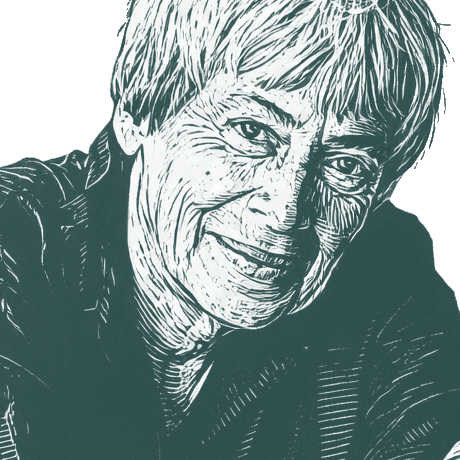
He explained to Atro that he now understood why the army was organized as it was. It was indeed quite necessary. No rational form of organization wou… - Ursula K. Le Guin
""
He explained to Atro that he now understood why the army was organized as it was. It was indeed quite necessary. No rational form of organization would serve the purpose. He simply had not understood that the purpose was to enable men with machine guns to kill unarmed men and women easily and in great quantities when told to do so. Only he still could not see where courage, or manliness, or fitness entered in.
Ursula K. Le Guin (21 October 1929 – 22 January 2018) was an American writer, known mostly for her work in science fiction and fantasy. She received the Hugo Award, Nebula Award, Locus Award, and World Fantasy Award, and was made a Grandmaster of Science Fiction in 2003.
Biography information from
Wikiquote·
Portrait adapted from
Wikimedia Commons, Marian Wood Kolisch, Oregon State University Restored by Adam Cuerden (CC BY-SA)
Also Known As
Birth Name:
Ursula Kroeber
Alternative Names:
Ursula Kroeber Le Guin
•
Ursula Le Guin
Portrait from Wikimedia Commons. Credit: Marian Wood Kolisch, Oregon State University Restored by Adam Cuerden. Used under CC BY-SA. Processed and styled by Quotewise.
Limited Time Offer
Premium members can get their quote collection automatically imported into their Quotewise collections.
There was a wall. It did not look important. It was built of uncut rocks roughly mortared. An adult could look right over it, and even a child could climb it. Where it crossed the roadway, instead of having a gate it degenerated into mere geometry, a line, an idea of boundary. But the idea was real. It was important. For seven generations there had been nothing in the world more important than that wall. Like all walls it was ambiguous, two-faced. What was inside it and what was outside it depended upon which side of it you were on.
I think what you mostly do when you find you really are alone is to panic. You rush to the opposite extreme and pack yourself into groups - clubs, teams, societies, types. You suddenly start dressing exactly like the others. It's a way of being invisible. The way you sew the patches on the holes in your blue jeans becomes incredibly important. If you do it wrong you're not with it. That's a peculiar phrase, you know? With it. With what? With them. With the others. All together. Safety in numbers. I'm not me. I'm a basketball letter. I'm a popular kid. I'm my friend's friend. I'm a black leather growth on a Honda. I'm a member. I'm a teenager. You can't see me, all you can see is us. We're safe. And if We see You standing alone by yourself, if you're lucky we'll ignore you. If you're not lucky, we might throw rocks. Because we don't like people standing there with the wrong kind of patches on their jeans reminding us that we're each alone and none of us is safe.
Works in ChatGPT, Claude, or Any AI
Add semantic quote search to your AI assistant via MCP. One command setup.
I have written so often of how and why it took me so long to write the six books of Earthsea that the story has become like the book you have to read to your four-year-old every night for weeks—You really want to hear it again? Oh well, okay, here goes! I wrote the first three books in five years: ’68, ’70, ’72. I was on a roll. None of them was closely plotted or planned before writing; in each of them much of the story came to me as I followed what I wrote where it inevitably led. I started confidently on the fourth book. The central character was Tenar again, of course, to balance it out. I knew she hadn’t stayed and studied wizardry with Ogion, but had married a farmer and had children, and that the story was going to bring her and Ged back together. But by the middle of the first chapter, I realized that I didn’t know who she was—now. I didn’t know why she’d done what she’d done or what she had to do. I didn’t know her story, or Ged’s. I couldn’t plot or plan it. I couldn’t write it. It took me eighteen years to learn how.