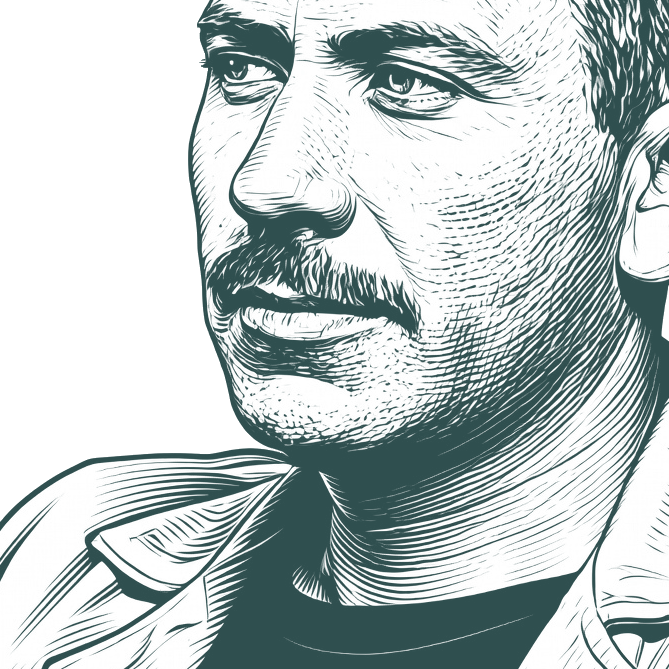
"Once Ed said to me, "For a very long time I didn't like myself." It was not said in self-pity but simply as an unfortunate fact. "It was a very diff… - John Steinbeck
"Once Ed said to me, "For a very long time I didn't like myself." It was not said in self-pity but simply as an unfortunate fact. "It was a very difficult time," he said, "and very painful. I did not like myself for a number of reasons, some of them valid and some of them pure fancy. I would hate to have to go back to that. Then gradually," he said, "I discovered with surprise and pleasure that a number of people did like me. And I thought, if they can like me, why cannot I like myself? Just thinking it did not do it, but slowly I learned to like myself and then it was all right." This was not said in self-love in its bad connotation but in self-knowledge. He meant literally that he had learned to accept and like the person "Ed" as he liked other people. It gave him a great advantage. Most people do not like themselves at all. They distrust themselves, put on masks and pomposities. They quarrel and boast and pretend and are jealous because they do not like themselves. But mostly they do not even know themselves well enough to form a true liking. They cannot see themselves well enough to form a true liking, and since we automatically fear and dislike strangers, we fear and dislike our stranger-selves."
John Ernst Steinbeck Jr. (27 February 1902 – 20 December 1968) was an American writer. A recipient of the Nobel Prize for Literature in 1962, his works include the novella Of Mice and Men (1937) and the novel The Grapes of Wrath (1939, Pulitzer Prize for Fiction, 1940), both of which examine the lives of the working class and migrant workers during the Great Depression.
Biography information from
Wikiquote·
Portrait adapted from
Wikimedia Commons, McFadden Publications, Inc.; no photographer credited; photo likely the work of Sonya Noskowiak, as Steinbeck is wearing the same clothes from her 1935 studio session that produced the work shown here: https://www.si.edu/object/npg_NPG.2006.74 (Public domain / CC0)
Also Known As
Birth Name:
Jeffery Ernest Steinbeck
Alternative Names:
John Ernst Steinbeck, Jr.
•
John Ernst Steinbeck
•
John Ernest Steinbeck
•
John Ernst Steinbeck Jr
•
Steinbeck
Money does not change the sickness, only the symptoms.
Just as there are physical monsters, can there not be mental or psychic monsters born? The face and body may be perfect, but if a twisted gene or malformed egg can produce physical monsters, may not the same process produce a malformed soul?
Monsters are variations from the accepted normal to a greater or a less degree. As a child may be born without an arm, so one may be born without kindness or the potential of conscience. A man who loses his arms in an accident has a great struggle to adjust himself to the lack, but one born without arms suffers only from people who find him strange. Having never had arms, he cannot miss them. To a monster the norm must seem monstrous, since everyone is normal to himself. To the inner monster it must be even more obscure, since he has no visible thing to compare with others. To a criminal, honesty is foolish. You must not forget that a monster is only a variation, and that to a monster the norm is monstrous.
It is better to sit in appreciative contemplation of a world in which beauty is eternally supported on a foundation of ugliness: cut out the support, and beauty will sink from sight.