Already an old man, he [Samuel Johnson] ventured on his Highland tour; and his heart, bound with triple brass, did not recoil before twenty-seven ind… - Robert Louis Stevenson
""
Already an old man, he [Samuel Johnson] ventured on his Highland tour; and his heart, bound with triple brass, did not recoil before twenty-seven individual cups of tea.
English
Collect this quote
About
Robert Louis Stevenson
Robert Louis (Balfour) Stevenson (13 November 1850 – 3 December 1894) was a Scottish novelist, poet, and travel writer, and a representative of Neo-romanticism.
Biography information from
Wikiquote·
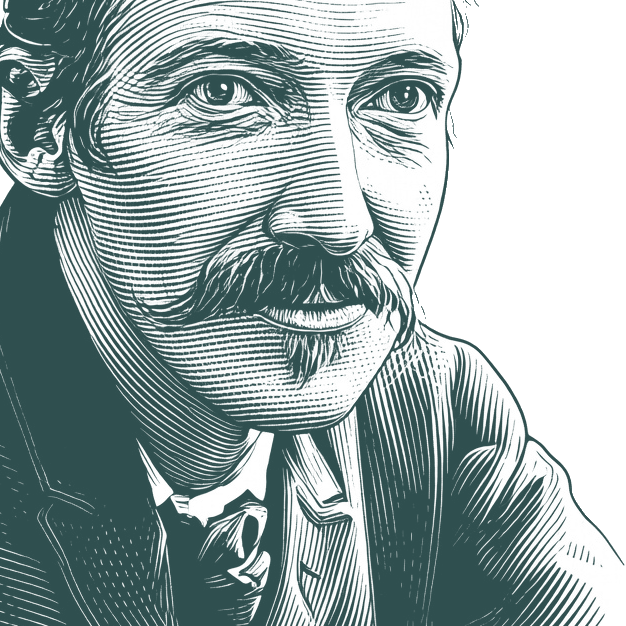
Portrait adapted from
Wikimedia Commons, Henry Walter Barnett (Public domain / CC0)
Also Known As
Alternative Names:
Robert Luis Stivensoni
•
Shih-ti-wen-sheng
•
Stivenson
•
Robert Loui Sitivensin
•
Robert Louis Balfour Stevenson
•
Robert Lui Stivenson
•
RL Stivenson
•
RL Stevenson
•
RLS
•
R. L. Stevenson
•
Robert Lewis Balfour Stevenson
When a man is in a fair way and sees all life open in front of him, he seems to himself to make a very important figure in the world. His horse whinnies to him; the trumpets blow and the girls look out of window as he rides into town before his company; he receives many assurances of trust and regard--sometimes by express in a letter--sometimes face to face, with persons of great consequence falling on his neck. It is not wonderful if his head is turned for a time. But once he is dead, were he as brave as Hercules or as wise as Solomon, he is soon forgotten.
You must suffer me to go my own dark way.
Works in ChatGPT, Claude, or Any AI
Add semantic quote search to your AI assistant via MCP. One command setup.
Squire Trelawney, Dr. Livesey, and the rest of these gentlemen having asked me to write down the whole particulars about Treasure Island, from the beginning to the end, keeping nothing back but the bearings of the island, and that only because there is still treasure not yet lifted, I take up my pen in the year of grace 17 — , and go back to the time when my father kept the Admiral Benbow inn and the brown old seaman with the sabre cut first took up his lodging under our roof. I remember him as if it were yesterday, as he came plodding to the inn door, his sea-chest following behind him in a hand-barrow — a tall, strong, heavy, nut-brown man, his tarry pigtail falling over the shoulder of his soiled blue coat, his hands ragged and scarred, with black, broken nails, and the sabre cut across one cheek, a dirty, livid white. I remember him looking round the cover and whistling to himself as he did so, and then breaking out in that old sea-song that he sang so often afterwards: