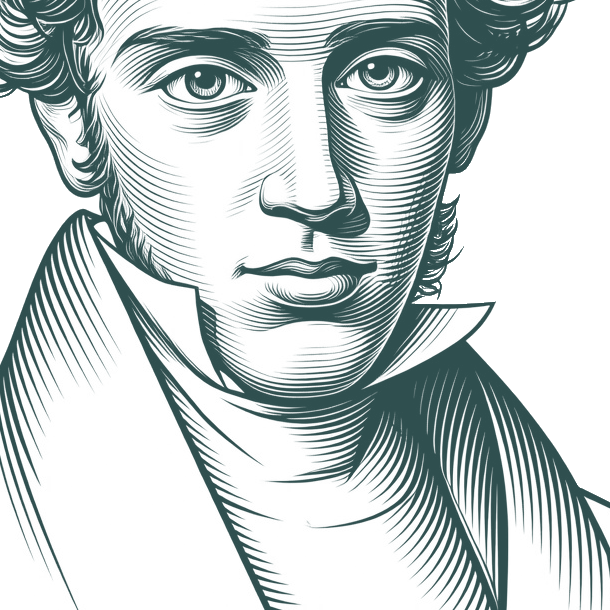
The thing is to understand myself: the thing is to find a truth which is true for me, to find the idea for which I can live and die. That is what I n… - Søren Kierkegaard
""
The thing is to understand myself: the thing is to find a truth which is true for me, to find the idea for which I can live and die. That is what I now recognize as the most important thing.
English
Collect this quote
About
Søren Kierkegaard
Søren Aabye Kierkegaard (5 May 1813 – 11 November 1855) was a Danish Christian philosopher and theologian, considered to be a founder of Existentialist thought and Absurdist traditions. He wrote critical texts on organized religion, Christendom, morality, ethics, psychology and philosophy of religion, displaying a fondness for metaphor, irony and parables.
Biography information from
Wikiquote·
Portrait adapted from
Wikimedia Commons, La Biblioteca Real de Dinamarca (Public domain / CC0)
Also Known As
Pen Names:
Victor Eremita
•
A
•
Judge William
•
Johannes de silentio
•
Constantine Constantius
•
Young Man
•
Vigilius Haufniensis
•
Nicolaus Notabene
•
Hilarius Bookbinder
•
Johannes Climacus
•
Inter et Inter
•
H.H.
•
Anti-Climacus
•
B
•
Johannes de Silentio
•
Constantin Constantius
•
P. CH. Kierkegaard
Native Name:
Søren Aabye Kierkegaard
Alternative Names:
Kierkegaard
•
Climacus
•
Sören Aaby Kierkegaard
"يقول مثل قديم مأخوذ من العالم الخارجي المرئي "لن ينال الخبز إلا الرجل الكادح" والغريب أن هذا المثل لا ينطبق بصدق في ذلك العالم الذي ينتمي إليه بجلاء ذلك أن عالم الظاهر خاضع لقانون النقص-وفيه تتكرر حيناً بعد آخر تلك التجربة التي نرى فيها أن من لا يعمل يحصل أيضاً على الخبز-بل إن من ينام يحصل عليه بوفرة أكثر من الرجل الكادح،فهذا العالم اسير لقانون عدم الاكتراث(أو قانون استواء الطرفين)-أما في عالم الروح فالأمر جد مختلف-فهنا يسود النظام الإلهي الأبدي-وهنا لا تمطر السماء على العادل والظالم سواء-وهنا لا تشرق الشمس على الطيب والشرير معاً-وهنا ينطبق ذلك المثل-من يعمل هو وحده الذي يحصل على الخبز-ومن لا يعمل لا يحصل على الخبز بل يبقى مخدوعاً-وأن من يحيا في القلق وحده الذي يجد الراحة-وأن من يشهر السكين هو وحده الذي ينقذ اسحق"
If I am capable of grasping God objectively, I do not believe, but precisely because I cannot do this I must believe. If I wish to preserve myself in faith I must constantly be intent upon holding fast the objective uncertainty so as to remain out upon the deep, over seventy thousand fathoms of water, still preserving my faith.
What ability there is in an individual may be measured by the yardstick of how far there is between his understanding and his will. What a person can understand he must also be able to force himself to will. Between understanding and willing is where excuses and evasions have their being.