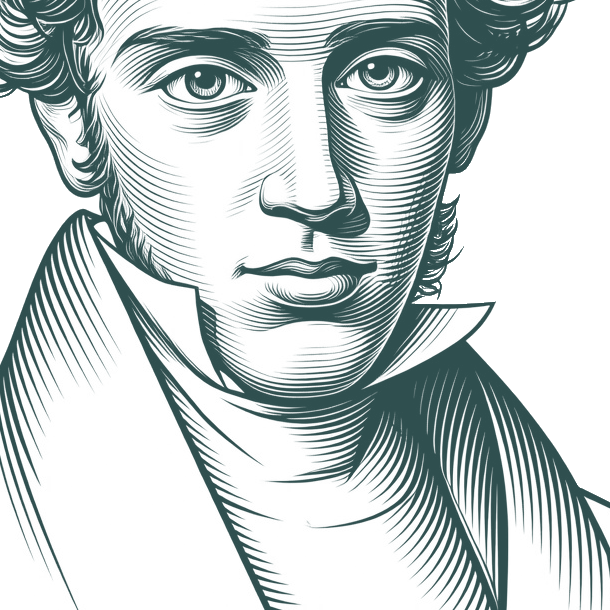
What am I? The modest narrator who accompanies your triumphs; the dancer who supports you when you rise in your lovely grace; the branch upon which y… - Søren Kierkegaard
""
What am I? The modest narrator who accompanies your triumphs; the dancer who supports you when you rise in your lovely grace; the branch upon which you rest a moment when you are tired of flying; the bass that interposes itself below the soprano’s fervour to let it climb even higher — what am I? I am the earthly gravity that keeps you on the ground. What am I, then? Body, mass, earth, dust and ashes. — You, my Cordelia, you are soul and spirit.” — Johannes the Seducer, from_Either/Or_
Søren Aabye Kierkegaard (5 May 1813 – 11 November 1855) was a Danish Christian philosopher and theologian, considered to be a founder of Existentialist thought and Absurdist traditions. He wrote critical texts on organized religion, Christendom, morality, ethics, psychology and philosophy of religion, displaying a fondness for metaphor, irony and parables.
Biography information from
Wikiquote·
Portrait adapted from
Wikimedia Commons, La Biblioteca Real de Dinamarca (Public domain / CC0)
Also Known As
Pen Names:
Victor Eremita
•
A
•
Judge William
•
Johannes de silentio
•
Constantine Constantius
•
Young Man
•
Vigilius Haufniensis
•
Nicolaus Notabene
•
Hilarius Bookbinder
•
Johannes Climacus
•
Inter et Inter
•
H.H.
•
Anti-Climacus
•
B
•
Johannes de Silentio
•
Constantin Constantius
•
P. CH. Kierkegaard
Native Name:
Søren Aabye Kierkegaard
Alternative Names:
Kierkegaard
•
Climacus
•
Sören Aaby Kierkegaard
In vain do individual great men seek to mint new concepts and to set them in circulation — it is pointless. They are used for only a moment, and not by many, either, and they merely contribute to making the confusion even worse, for one idea seems to have become the fixed idea of the age: to get the better of one's superior. If the past may be charged with a certain indolent self-satisfaction in rejoicing over what it had, it would indeed be a shame to make the same charge against the present age (the minuet of the past and the gallop of the present). Under a curious delusion, the one cries out incessantly that he has surpassed the other, just as the Copenhageners, with philosophic visage, go out to Dyrehausen "in order to see and observe," without remembering that they themselves become objects for the others, who have also gone out simply to see and observe. Thus there is the continuous leap-frogging of one over the other — "on the basis of the immanent negativity of the concept", as I heard a Hegelian say recently, when he pressed my hand and made a run preliminary to jumping. — When I see someone energetically walking along the street, I am certain that his joyous shout, "I am coming over," is to me — but unfortunately I did not hear who was called (this actually happened); I will leave a blank for the name, so everyone can fill in an appropriate name.
The levelling process is the victory of abstraction over the individual. The levelling process in modern times, corresponds, in reflection, to fate in antiquity.
Works in ChatGPT, Claude, or Any AI
Add semantic quote search to your AI assistant via MCP. One command setup.
A Roman emperor sitting at the table surrounded by his bodyguard is a magnificent sight, but when the reason is fear, the magnificence pales. So also when the individual does not dare stand taciturnly by his word, does not stand freely and confidently on the pedestal of a conscious act, but is surrounded by a host of deliberations before and after that render him incapable of getting his eye on the action.