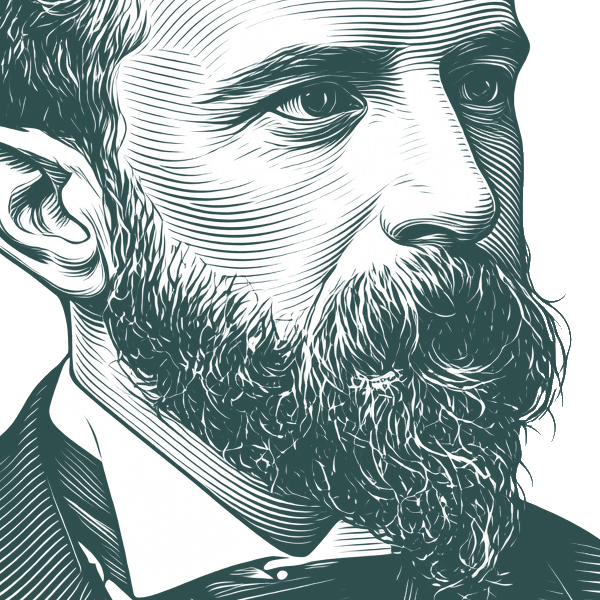
The profoundest lessons are not the lessons of reason; they are sudden strains that permanently warp the mind. - Henry Adams
""
The profoundest lessons are not the lessons of reason; they are sudden strains that permanently warp the mind.
English
Collect this quote
About
Henry Adams
Henry Brooks Adams (16 February 1838 – 27 March 1918) was a U.S. historian, journalist, novelist and educator. He was the great-grandson of John Adams, grandson of John Quincy Adams and son of Charles Francis Adams, Sr.
Biography information from
Wikiquote·
Portrait adapted from
Wikimedia Commons, William Notman (Public domain / CC0)
On May 13, he met the official announcement that England recognized the belligerency of the Confederacy. This beginning of a new education tore up by the roots nearly all that was left of Harvard College and Germany. He had to learn — the sooner the better — that his ideas were the reverse of truth; that in May, 1861, no one in England — literally no one — doubted that Jefferson Davis had made or would make a nation, and nearly all were glad of it, though not often saying so. They mostly imitated Palmerston who, according to Mr. Gladstone, “desired the severance as a diminution of a dangerous power, but prudently held his tongue.” The sentiment of anti-slavery had disappeared.
...analogies [...] are figures intended to serve as fatal weapons if they succeed, and as innocent toys if they fail.
As a type for study, or a standard for education, Lodge was the more interesting of the two. Roosevelts are born and never can be taught; but Lodge was a creature of teaching — Boston incarnate — the child of his local parentage; and while his ambition led him to be more, the intent, though virtuous, was — as Adams admitted in his own case — restless. An excellent talker, a voracious reader, a ready wit, an accomplished orator, with a clear mind and a powerful memory, he could never feel perfectly at ease whatever leg he stood on, but shifted, sometimes with painful strain of temper, from one sensitive muscle to another, uncertain whether to pose as an uncompromising Yankee; or a pure American; or a patriot in the still purer atmosphere of Irish, Germans, or Jews; or a scholar and historian of Harvard College. English to the last fibre of his thought — saturated with English literature, English tradition, English taste — revolted by every vice and by most virtues of Frenchmen and Germans, or any other Continental standards, but at home and happy among the vices and extravagances of Shakespeare — standing first on the social, then on the political foot; now worshipping, now banning; shocked by the wanton display of immorality, but practicing the license of political usage; sometimes bitter, often genial, always intelligent — Lodge had the singular merit of interesting. The usual statesmen flocked in swarms like crows, black and monotonous. Lodge's plumage was varied, and, like his flight, harked back to race. He betrayed the consciousness that he and his people had a past, if they dared but avow it, and might have a future, if they could but divine it.