All they have touched or seen they make their own,
In Nature’s basement lodge, mind’s passages fill,
Disrupt thought’s links and musing sequences,
Br… - Aurobindo Ghosh
""
All they have touched or seen they make their own, In Nature’s basement lodge, mind’s passages fill, Disrupt thought’s links and musing sequences, Break through the soul’s stillness with a noise and cry Or they call the inhabitants of the abyss, Invite the instincts to forbidden joys, A laughter wake of dread demoniac mirth And with nether riot and revel shake life’s floor.
Impotent to quell his terrible prisoners Appalled the householder helpless sits above, Taken from him his house is his no more.
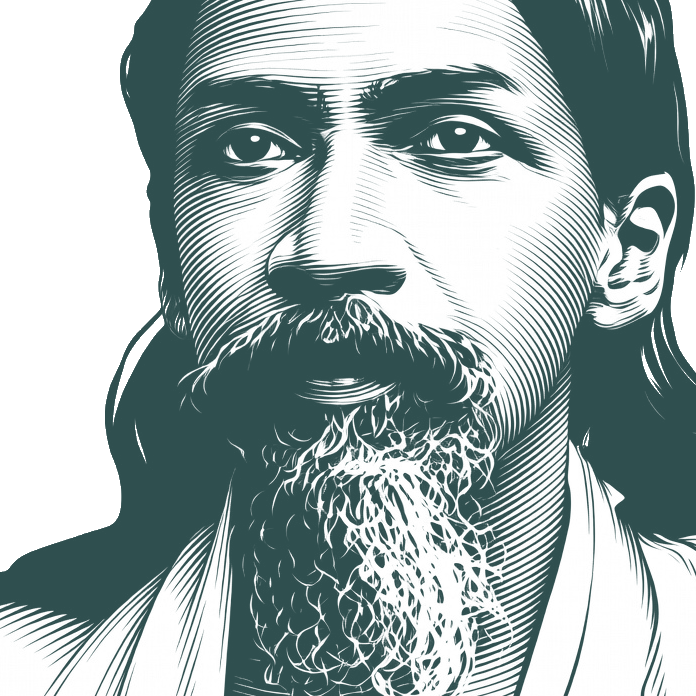
Sri Aurobindo [born Aravinda Akroyd Ghose] (15 August 1872 – 5 December 1950) was an Indian nationalist, scholar, poet, mystic, philosopher, yogi and guru, who developed concepts of human progress and spiritual evolution. With the help of his spiritual collaborator, Mirra Alfassa, he founded the Sri Aurobindo Ashram.
Biography information from
Wikiquote·
Portrait adapted from
Wikimedia Commons, Rudolf 1922 (Public domain / CC0)
Also Known As
Native Name:
অরবিন্দ ঘোষ
Alternative Names:
Sri Aurobindo Ghose
•
Sri Orobindo
•
Orobindo Ghosh
•
Shri Aurobindo
•
Aurobindo Ghose
•
Sri Aurobindo
•
Aurobindo
•
Aravinda Ackroyd Ghose
•
A.A.Ghosh
•
A.G.
•
Maharshi Aravind Babu
Terrorism thrives on administrative violence and injustice; that is the only atmosphere in which it can thrive and grow. It sometimes follows the example of indiscriminate violence from above; it sometimes, though very rarely, sets it from below. But the power above which follows the example from below is on the way to committing suicide.
Inflicting on the heights the abysm’s law, It sullies with its mire heaven’s messengers: Its thorns of fallen nature are the defence It turns against the saviour hands of Grace; It meets the sons of God with death and pain. 01.01_002:012
Works in ChatGPT, Claude, or Any AI
Add semantic quote search to your AI assistant via MCP. One command setup.
The second message came and it said, "Something has been shown to you in this year of seclusion, something about which you had your doubts and it is the truth of the Hindu religion. It is this religion that I am raising up before the world, it is this that I have perfected and developed through the Rishis, saints and Avatars, and now it is going forth to do my work among the nations. I am raising up this nation to send forth my word. This is the Sanatan Dharma, this is the eternal religion which you did not really know before, but which I have now revealed to you. The agnostic and the sceptic in you have been answered, for I have given you proofs within and without you, physical and subjective, which have satisfied you. When you go forth, speak to your nation always this word, that it is for the Sanatan Dharma that they arise, it is for the world and not for themselves that they arise. I am giving them freedom for the service of the world. When therefore it is said that India shall rise, it is the Sanatan Dharma that shall be great. When it is said that India shall expand and extend herself, it is the Sanatan Dharma that shall expand and extend itself over the world. It is for the Dharma and by the Dharma that India exists. To magnify the religion means to magnify the country. I have shown you that I am everywhere and in all men and in all things, that I am in this movement and I am not only working in those who are striving for the country but I am working also in those who oppose them and stand in their path. I am working in everybody and whatever men may think or do, they can do nothing but help in my purpose. They also are doing my work, they are not my enemies but my instruments. In all your actions you are moving forward without knowing which way you move. You mean to do one thing and you do another. You aim at a result and your efforts subserve one that is different or contrary. It is Shakti that has gone forth and entered into the people. Since long ago I have been preparing this uprising and now the time has come and it is I who will lead it to its fulfilment."