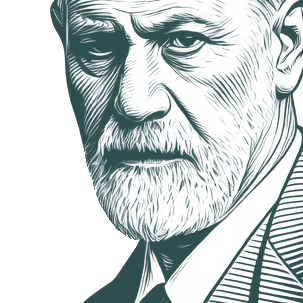
The sexual wishes in regard to the mother become more intense and the father is perceived as an obstacle to the mother; this gives rise to the Oedipu… - Sigmund Freud
""
The sexual wishes in regard to the mother become more intense and the father is perceived as an obstacle to the mother; this gives rise to the Oedipus complex.
Sigmund Freud ([ˈziːgmʊnt ˈfrɔʏ̯t]; 6 May 1856 – 23 September 1939) was an Austrian neurologist and psychiatrist and the founder of the psychoanalytic school of psychology. He was the father of Anna Freud, the grandfather of Sir Clement Freud and Lucian Freud, and the uncle of Edward Bernays.
Biography information from
Wikiquote·
Portrait adapted from
Wikimedia Commons, Max Halberstadt (Public domain / CC0)
Religion has clearly performed great services for human civilization. It has contributed much towards the taming of the asocial instincts. But not enough. It has ruled human society for many thousands of years and has had time to show what it can achieve. If it had succeeded in making the majority of mankind happy, in comforting them, in reconciling them to life and in making them into vehicles of civilization, no one would dream of attempting to alter the existing conditions. But what do we see instead? We see that an appallingly large number of people are dissatisfied with civilization and unhappy in it, and feel it as a yoke which must be shaken off; and that these people either do everything in their power to change that civilization, or else go so far in their hostility to it that they will have nothing to do with civilization or with a restriction of instinct. At this point it will be objected against us that this state of affairs is due to the very fact that religion has lost a part of its influence over human masses precisely because of the deplorable effect of the advances of science. We will note this admission and the reason given for it, and we shall make use of it later for our own purposes; but the objection itself has no force.
It is doubtful whether men were in general happier at a time when religious doctrines held unrestricted sway; more moral they certainly were not. They have always known how to externalize the precepts of religion and thus to nullify their intentions. The priests, whose duty it was to ensure obedience to religion, met them half-way in this. God's kindness must lay a restraining hand on His justice. One sinned, and then one made a sacrifice or did penance and then one was free to sin once more. Russian introspectiveness has reached the pitch of concluding that sin is indispensable for the enjoyment of all the blessings of divine grace, so that, at bottom, sin is pleasing to God. It is no secret that the priests could only keep t
In general we are reminded that the word heimlich is not unambiguous, but belongs to two sets of ideas, which, without being contradictory, are yet very different: on the one hand it means what is familiar and agreeable, and on the other, what is concealed and kept out of sight. Unheimlich is customarily used, we are told, as the contrary only of the first signification of heimlich, and not of the second. [...] On the other hand, we notice that Schelling says something which throws quite a new light on the concept of the Unheimlich, for which we were certainly not prepared. According to him, everything is unheimlich that ought to have remained secret and hidden but has come to light.
Works in ChatGPT, Claude, or Any AI
Add semantic quote search to your AI assistant via MCP. One command setup.
The Mosaic religion had been a Father religion; Christianity became a Son religion. The old God, the Father, took second place; Christ, the Son, stood in His stead, just as in those dark times every son had longed to do.