Imagine what it would be like for our descendants to experience the fall of civilization. Imagine failures of reasonableness so total that our larges… - Sam Harris
""
Imagine what it would be like for our descendants to experience the fall of civilization. Imagine failures of reasonableness so total that our largest bombs finally fall upon our largest cities in defense of our religious differences. What would it be like for the unlucky survivors of such a holocaust to look back upon the hurtling career of human stupidity that led them over the precipice? A view from the end of the world would surely find that the six billion of us currently alive did much to pave the way to the Apocalypse.
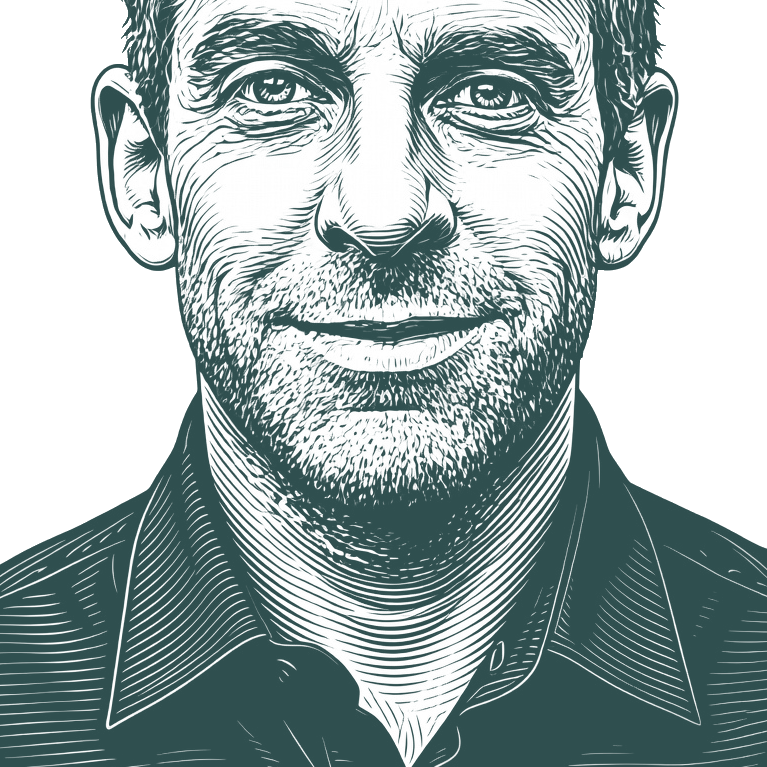
Samuel Benjamin Harris (born April 9, 1967) is an American author, philosopher, public intellectual, and neuroscientist, as well as the co-founder and CEO of Project Reason. He is the author of The End of Faith (2004), which won the PEN/Martha Albrand Award for First Nonfiction in 2005 and appeared on The New York Times best seller list for 33 weeks, Letter to a Christian Nation (2006), The Moral Landscape (2010), Lying (2011), Free Will (2012), and most recently Waking Up: A Guide to Spirituality Without Religion (2014).
Biography information from
Wikiquote·
Portrait adapted from
Wikimedia Commons, Cmichel67 (Christopher Michel) (CC BY-SA)
"There seems, however, to be a problem with some of our more cherished beliefs about the world: they are leading us, inexorably, to kill one another. A glance at history, or at the pages of any newspaper, reveals that ideas which divide one group of human beings from another, only to unite them in slaughter, generally have their roots in religion. it seems that if our species ever eradicates itself through war, it will not be because it was written in the stars but because it was written in our books; it is what we do with words like "God" and "paradise" and "sin" in the present that will determine our future."
Losing a belief in free will has not made me fatalistic — in fact, it has increased my feelings of freedom. My hopes, fears, and neuroses seem less personal and indelible. There is no telling how much I might change in the future. Just as one wouldn’t draw a lasting conclusion about oneself on the basis of a brief experience of indigestion, one needn’t do so on the basis of how one has thought or behaved for vast stretches of time in the past. A creative change of inputs to the system — learning new skills, forming new relationships, adopting new habits of attention — may radically transform one’s life.
One of the enduring pathologies of human culture is the tendency to raise children to fear and demonize other human beings on the basis of religious faith. Consequently, faith inspires violence in at least two ways. First, people often kill other human beings because they believe that the creator of the universe wants them to do it. Islamist terrorism is a recent example of this sort of behavior. Second, far greater numbers of people fall into conflict with one another because they define their moral community on the basis of the religious affiliation: Muslims side with other Muslims, Protestants with Protestants, Catholics with Catholics. These conflicts are not always explicitly religious. But the bigotry and hatred that divide one community from another are often the products of their religious identities.