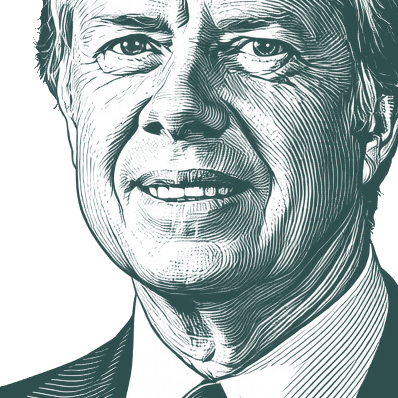
War may sometimes be a necessary evil. But no matter how necessary, it is always an evil, never a good. We will not learn to live together in peace b… - Jimmy Carter

" "

War may sometimes be a necessary evil. But no matter how necessary, it is always an evil, never a good. We will not learn to live together in peace by killing each other's children.

English
Collect this quote

About Jimmy Carter

James Earl Carter, Jr. (October 1, 1924 – December 29, 2024) was an American politician and member of the Democratic Party who served as the 39th president of the United States from 1977 to 1981. In 1982 he established the Carter Center, as a base for promoting human rights, democracy, finding peaceful solutions to international conflicts, and advancing economic and social development, for which he was awarded the Nobel Peace Prize in 2002. He was a key figure in the Habitat for Humanity project, and has been noted for his criticism of Israel's role in the Israeli–Palestinian conflict.

Biography information from Wikiquote

Also Known As

Birth Name: James Earl Carter Jr.
Alternative Names: James E. Carter James Carter James Earl Carter 39th President of the United States James E. Carter Jr. James Earl Carter, Jr. James E. Carter, Jr.
PREMIUM FEATURE
Advanced Search Filters

Filter search results by source, date, and more with our premium search tools.

Related quotes. More quotes will automatically load as you scroll down, or you can use the load more buttons.

Shorter versions of this quote

We will not learn how to live together in peace by killing each other's children.

Additional quotes by Jimmy Carter

You might say one person can't make much difference. I remember in 1960 if 28,000 people had changed their votes in Texas and a few thousand in Illinois, John Kennedy would never have been President. In 1968 if all of the people assembled here and a few like you around the country had had the confidence in the Democratic candidate to go out and work hard for him, Richard Nixon would never have served in the White House, and we would have had a great Democratic President, Hubert Humphrey, to carry on the principles that I've described to you. But when you think back on Roosevelt, Harry Truman, Johnson, Kennedy, those memories, for working people, for people who believe in a strong defense and for peace, for people who believe in a brighter future for our country, better education for our children, self-respect for the elderly, dignity for those who are black or who don't speak English well, but might speak Spanish, are very important. And our country has taken the leadership in recent years in trying to bring peace not only to our own Nation but to others. I've been proud to represent you in negotiating with President Sadat and Prime Minister Begin to bring peace to Israel. And I see this not just as an achievement for Israel, to make sure that they are secure and strong and democratic and free and at peace, but that investment there by the people of our Nation, with me as your leader, has given our own Nation more stability, more security, more chance for freedom and for peace, and has stabilized a very troubled area of the world. These kind of strategic common relationships that bind us together with foreign countries are important to us all. I'm grateful to you for what you mean to me in the past and in the present, and I'm even more grateful for what you're going to mean to me 2 weeks from now when you have helped to elect me and Fritz Mondale to another term in office.

Thank you all. I'm sorry I have to go, but I've got another meeting in a few minutes. I've enjoyed it, and I hope that you had a chance to meet with some of our staff members. I didn't make a speech at first, but I would like to say that it's important to us to have you come here. We learn, I'm sure, a lot more from listening to your questions and from my staff members talking to you about domestic and foreign affairs than you learn from us. And I think it's important for your readers and listeners and viewers to know that this is their White House, and that we don't have anything to conceal here. We've made mistakes. We're obviously going to make them, like you do at home in your own business. But we don't try to cover up, conceal anything. I've enjoyed the press conferences twice a week. Cy Vance has a press conference every month. It happens to be this afternoon. And on many of the controversial issues that in the past have been decided in a very secret way between the Secretary of State and the President, for instance, are now discussed openly with the American people. I feel that's a good move. It exposes our doubts and uncertainties and controversies on occasion, but after that debate goes back and forth in the Congress and throughout the Nation, among American people, we monitor that opinion very closely. And I think that by the time I make a decision--which may or may not always agree with what the people are thinking at home--I have a much surer sense of what our country ought to do. And I think that foreign countries feel, for instance, that when I speak or Cy Vance speaks or the Vice President, that we speak for the country. We also do the same thing with the Congress. I've met with every single Member of the Congress, Democrat and Republican, unless they just didn't come when they were invited. And if they missed one meeting, they've been invited to subsequent meetings. You know, very recently, I've had breakfast with all the Democratic Members of the Senate, and now we're starting to have breakfast with all the Republican Members. We've spent an hour and a half just sitting around a small table, and let them bring up any subject they want to me and I answer any question they ask me.

PREMIUM FEATURE
Advanced Search Filters

Filter search results by source, date, and more with our premium search tools.

Our energy plan will also include a number of specific goals to measure our progress toward a stable energy system. These are the goals that we set for 1985: to reduce the annual growth rate in our energy demand to less than 2 percent; to reduce gasoline consumption by 10 percent below its. current level; to cut in half the portion of U.S. oil which is imported--from a potential level of 16 million barrels to 6 million barrels a day; to establish a strategic petroleum reserve of one billion barrels, more than a 6-months supply; to increase our coal production by about two-thirds to more than one billion tons a year; to insulate 90 percent of American homes and all new buildings; to use solar energy in more than 2 1/2 million houses. We will monitor our progress toward these goals year by year. Our plan will call for strict conservation measures if we fall behind. I can't tell you that these measures will be easy, nor will they be popular. But I think most of you realize that a policy which does not ask for changes or sacrifices would not be an effective policy at this late date. This plan is essential to protect our jobs, our environment, our standard of living, and our future. Whether this plan truly makes a difference will not be decided now here in Washington but in every town and every factory, in every home and on every highway and every farm. I believe that this can be a positive challenge. There is something especially American in the kinds of changes that we have to make. We've always been proud, through our history, of being efficient people. We've always been proud of our ingenuity, our skill at answering questions. Now we need efficiency and ingenuity more than ever. We've always been proud of our leadership in the world. And now we have a chance again to give the world a positive example. We've always been proud of our vision of the future. We've always wanted to give our children and our grandchildren a world richer in possibilities than we have had ourselves. They are the ones that we must provide for now. They are the ones who will suffer most if we don't act.

Loading...