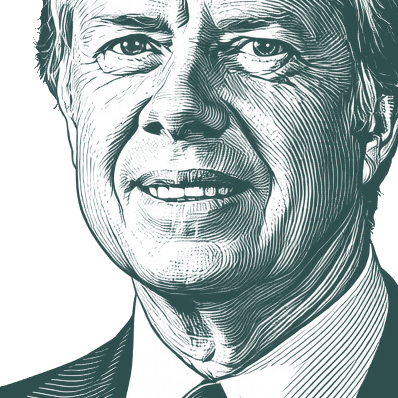
Well, we are not offering them any payment of money or anything, but we primarily capitalize on their clear determination, their clear desire to have… - Jimmy Carter
""
Well, we are not offering them any payment of money or anything, but we primarily capitalize on their clear determination, their clear desire to have peace. There is no doubt in my mind at all that President Asad, who has been one of the most highly critical leaders of what Sadat did--there's no doubt in my mind that President Asad wants peace with Israel, and there's no doubt in my mind that King Hussein wants peace with Israel. And sometimes it's very difficult for them to communicate directly with Israel. We act as an intermediary there. We meet with those leaders on both sides. Obviously, if there should be a breakthrough in the future, similar to what occurred between Egypt and Israel--let's say, for instance, that if King Hussein said he would like to negotiate directly with Prime Minister Begin, we would support that enthusiastically and offer our good offices to encourage such an interchange. But we don't have any inclination nor ability to dominate anyone nor to require them to take action contrary to what they think is in the best interests of their nation.
English
Collect this quote
About
Jimmy Carter
James Earl Carter, Jr. (October 1, 1924 – December 29, 2024) was an American politician and member of the Democratic Party who served as the 39th president of the United States from 1977 to 1981. In 1982 he established the Carter Center, as a base for promoting human rights, democracy, finding peaceful solutions to international conflicts, and advancing economic and social development, for which he was awarded the Nobel Peace Prize in 2002. He was a key figure in the Habitat for Humanity project, and has been noted for his criticism of Israel's role in the Israeli–Palestinian conflict.
Biography information from
Wikiquote·
Portrait adapted from
Wikimedia Commons, Department of Defense. Department of the Navy. Naval Photographic Center (Public domain / CC0)
Also Known As
Birth Name:
James Earl Carter Jr.
Alternative Names:
James E. Carter
•
James Carter
•
James Earl Carter
•
39th President of the United States
•
James E. Carter Jr.
•
James Earl Carter, Jr.
•
James E. Carter, Jr.
I don't think the U.N. has any jurisdiction. And particularly when this question is raised by Cuba, a government that has no respect for individual freedom or individual liberty and permits no vote of any kind in their own country, to accuse us of trying to subjugate the people of Puerto Rico, to me, is absolutely and patently ridiculous.
My faith demands - this is not optional - my faith demands that I do whatever I can, wherever I can, whenever I can, for as long as I can with whatever I have to try to make a difference.
Works in ChatGPT, Claude, or Any AI
Add semantic quote search to your AI assistant via MCP. One command setup.
I voted for Bernie the last time. But one of the major factors I have in my mind is who can beat Trump. Because I think it would be a disaster to have four more years of Trump.