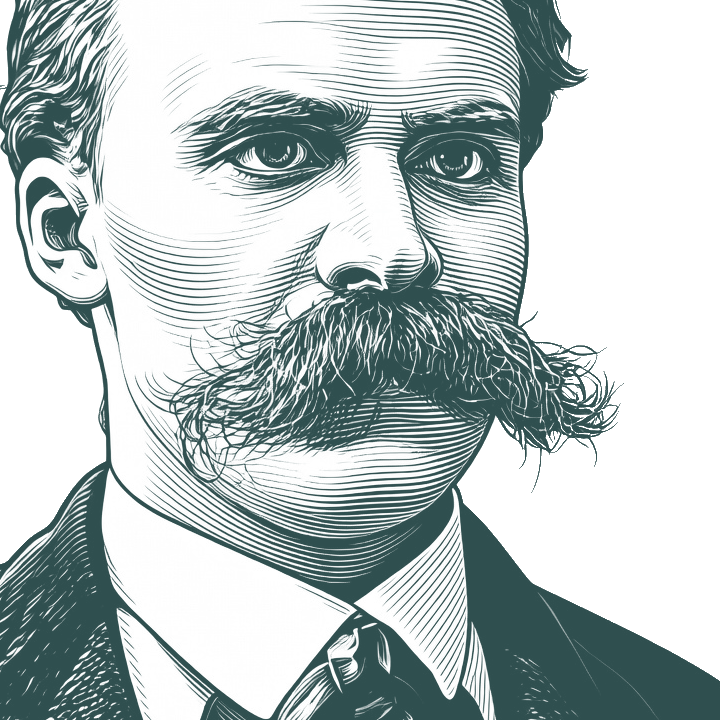
Healthy introspection, without undermining oneself; it is a rare gift to venture into the unexplored depths of the self, without delusions or fiction… - Friedrich Nietzsche
""
Healthy introspection, without undermining oneself; it is a rare gift to venture into the unexplored depths of the self, without delusions or fictions, but with an uncorrupted gaze.
Friedrich Wilhelm Nietzsche (15 October 1844 – 25 August 1900) was a German philosopher, cultural critic, composer, poet, writer, and philologist whose work has exerted a profound influence on modern intellectual history. His critiques of contemporary culture, religion, and philosophy centered on a basic question regarding the foundation of values and morality.
Biography information from
Wikiquote·
Portrait adapted from
Wikimedia Commons, Friedrich Hermann Hartmann (Public domain / CC0)
Also Known As
Alternative Names:
Friedrich Wilhelm Nietzsche
•
Nietzsche
Democracy and free speech are not facets of one gem; democracy and free speech are eternal enemies. But in any battle between an institution and an idea, the idea, in the long run, has the better of it. Here I do not venture into the absurdity of arguing that, as the world wags on, the truth always survives. I believe nothing of the sort. As a matter of fact, it seems to me that an idea that happens to be true — or, more exactly, as near to truth as any human idea can be, and yet remain generally intelligible — it seems to me that such an idea carries a special and often fatal handi cap. The majority of men prefer delusion to truth. It soothes. It is easy to grasp. Above all, it fits more snugly than the truth into a universe of false appearances — of complex and irrational phenomena,
A degree of culture, and assuredly a very high one, is attained when man rises above superstitions and religious notions and fears, and, for instance, no longer believes in guardian angels or in original sin, and has also ceased to talk of the salvation of his soul.
Unlimited Quote Collections
Organize your favorite quotes without limits. Create themed collections for every occasion with Premium.