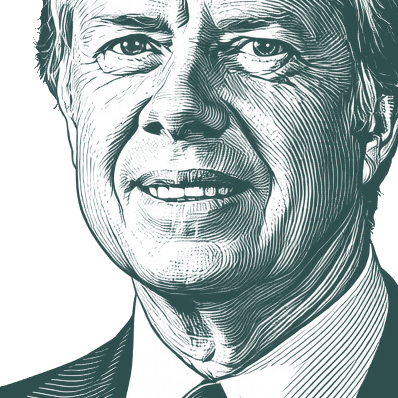
Our fourth major goal, I want to mention briefly, is our welfare system and our tax system. In both of these cases, tinkering is not going to be enou… - Jimmy Carter
""
Our fourth major goal, I want to mention briefly, is our welfare system and our tax system. In both of these cases, tinkering is not going to be enough. They must be thoroughly redesigned. Our present welfare system robs the taxpayers who support it, discourages the people who administer it, and sometimes degrades the people who really do need help. It's an extraordinarily complex and difficult problem, even more so than I had expected. Two weeks ago I outlined the principles that must underlie the reform of the system, and we will have legislative proposals ready by the end of this summer. We've already begun to move in this direction by simplifying the food stamp program--eliminating the purchase requirement and reforming the eligibility rules. As for our tax system, it, too, must be reformed through and through. Our tax system was once relatively simple, fair, and progressive. It isn't any more, because it's been changed so much over the years--often for the benefit of those who are rich enough to hire their own lobbyists in Washington. The process of redesign is well underway, and we intend to submit legislation to the Congress for a fair and simple income tax system this year.
English
Collect this quote
About
Jimmy Carter
James Earl Carter, Jr. (October 1, 1924 – December 29, 2024) was an American politician and member of the Democratic Party who served as the 39th president of the United States from 1977 to 1981. In 1982 he established the Carter Center, as a base for promoting human rights, democracy, finding peaceful solutions to international conflicts, and advancing economic and social development, for which he was awarded the Nobel Peace Prize in 2002. He was a key figure in the Habitat for Humanity project, and has been noted for his criticism of Israel's role in the Israeli–Palestinian conflict.
Biography information from
Wikiquote·
Portrait adapted from
Wikimedia Commons, Department of Defense. Department of the Navy. Naval Photographic Center (Public domain / CC0)
Also Known As
Birth Name:
James Earl Carter Jr.
Alternative Names:
James E. Carter
•
James Carter
•
James Earl Carter
•
39th President of the United States
•
James E. Carter Jr.
•
James Earl Carter, Jr.
•
James E. Carter, Jr.
Tonight, I went to the hotel room for a couple of hours before coming over here, and I wanted to write some notes for my speech. I thought back to a little more than 3 years ago when I first came to Iowa. I traveled across your State. I think I stopped in seven towns and cities. And I began to talk about issues that were important to you and important to me and important to our country. Quite often very few people came. Harry Baxter and his wife arranged for two or three hundred to come to a reception here in Des Moines. I think three people came, including Harry Baxter's wife and Jody Powell and one other. And I was invited over to the courthouse and went through and shook hands. But way back in those days we were already talking about human rights. We were talking about stopping the construction of the B-1 bomber. We were talking about bringing lasting peace to the Middle East. We were talking about holding down weapons sales, not only from our country, which is the worst violator of all, but among arms producers throughout the world. We were talking about a better relationship with the Soviet Union, a comprehensive SALT agreement that would put a limit on atomic weapons of all kinds. And we are making great progress on this effort. And I can tell you that in a few weeks, my prediction is that we will have a SALT agreement that will be a pride of our country, and following that, we will proceed toward my ultimate goal of reducing nuclear weapons in this world to zero. Back in those early days, even a year ago, there was a general feeling that nothing could be done to stop the proliferation of nuclear explosives among countries that presently don't have them. But in the last 9 months we have formed a commitment among the nations of the world to permit some use of atomic power to produce electricity, but to prevent the production of weapons. And I believe that we'll never see another nation again added to that horrible club that we started of countries that have nuclear destructive weapons in our repertoire.
One of the promises that I made to the farmers of this State and others during my campaign was there would be no more grain embargoes, and you can depend on that. There won't be as long as I'm in the White House. We're trying to establish, for instance, a noncommercial insurance program to make sure that farm product exporters are protected from losses that they can't anticipate. We're trying to expand Public Law 480 to increase the export of our farm products, food and fiber and feed, to nations that are destitute and hungry. We're trying to cut down artificial trade barriers in the multinational trade negotiations now going on in Europe. We're opening agricultural trade offices in places around the world where they haven't existed before. We're trying to make it possible for farmer-owned cooperatives to negotiate directly in the sale of feed grains and food grains. We're making sure that we bring together the different departments of our Federal Government in the common effort to sell agricultural products--the Labor Department, our Special Trade Representative, the Commerce Department, the State Department, as well as the Department of Agriculture. We're trying to establish a comprehensive world food policy to match the tremendous production that we have with the tremendous need among the hungry people of the world. And we're trying to explore new markets, not only in Western Europe and Japan but in Eastern Europe and other countries as well. So, in the export of food we're trying to increase the quality of service that the great farm areas of our Nation provide for the rest of the world. We've got a long way to go. We have to work out the problem with food reserves, and my promise to the farmers of this area was that when we did have high-yielding crops--and this is the greatest crop we have ever had in corn; it's the greatest crop we've ever had in soybeans that we would have reserves that would be not under the control of the Government, but supported and controlled by farmers so there can be no dumping on the market, artificially, to lower prices. And I promised you that we'd do the best I could to get the Government out of interference in the production, storage, and marketing of crops. These kinds of challenges are constantly on my mind. We have a long way to go in soil and water conservation efforts, and we've got a long way to go in providing a comprehensive disaster assistance program.
Works in ChatGPT, Claude, or Any AI
Add semantic quote search to your AI assistant via MCP. One command setup.
Thank you, Mr. Secretary General. Last night I was in Clinton, Massachusetts, at a Town Hall meeting where people of that small town decide their political and economic future. Tonight I speak to a similar meeting where people representing nations all over the world come here to decide their political and economic future. I am proud to be with you tonight in this house where the shared hopes of the world can find a voice. I have come here to express my own support and the continuing support of my country for the ideals of the United Nations. We are proud that for the 32 years since its creation, the United Nations has met on American soil. And we share with you the commitments of freedom, self-government, human dignity, mutual toleration, and the peaceful resolution of disputes--which the founding principles of the United Nations and also Secretary General Kurt Waldheim so well represent. No one nation by itself can build a world which reflects all these fine values. But the United States, my own country, has a reservoir of strength--economic strength, which we are willing to share; military strength, which we hope never to use again; and the strength of ideals, which are determined fully to maintain the backbone of our own foreign policy.