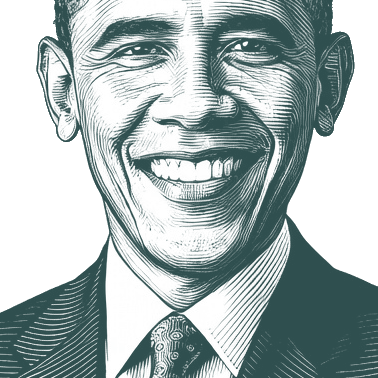
I do not want to see BP nickel and diming these businesses that are having a tough time. - Barack Obama
""
I do not want to see BP nickel and diming these businesses that are having a tough time.
English
Collect this quote
About
Barack Obama
Barack Hussein Obama II (born August 4, 1961) is an American politician who served as the 44th president of the United States of America from 2009 to 2017. Born in Hawaii, the son of a Kenyan father and a mother from Kansas, he won the 2008 presidential election and was re-elected president in November 2012. A member of the U.S. Democratic Party, he was the first African American president. Before becoming president, he represented the 13th district for three terms in the Illinois Senate from 1997 to 2004 and served as United States senator from Illinois between January 4, 2005 and November 16, 2008. While president, he was the recipient of the 2009 Nobel Peace Prize.
Biography information from
Wikiquote·
Portrait adapted from
Wikimedia Commons, Official White House Photo by Pete Souza (Public domain / CC0)
Also Known As
Birth Name:
Barack Hussein Obama II
Also Known As:Barry
Alternative Names:
POTUS 44
•
Barack Hussein Obama
•
Barack H. Obama
•
Barack Hussein Obama, Jr.
•
Barack H Obama
•
Barak Obama
•
Barry Obama
•
Barack Obama II
This weekend, as we celebrate , families across America will gather in backyards and front porches, fire up the barbeque, kick back with friends, and spend time with people they care about. That is as it should be. But I also hope that as you do so, you’ll take some time to reflect on what Memorial Day is all about; on why we set this day aside as a time of national remembrance.
In today's wars, many more civilians are killed than soldiers; the seeds of future conflict are sown, economies are wrecked, civil societies torn asunder, refugees amassed, children scarred. I do not bring with me today a definitive solution to the problems of war. What I do know is that meeting these challenges will require the same vision, hard work, and persistence of those men and women who acted so boldly decades ago. And it will require us to think in new ways about the notions of just war and the imperatives of a just peace. We must begin by acknowledging the hard truth: We will not eradicate violent conflict in our lifetimes. There will be times when nations — acting individually or in concert — will find the use of force not only necessary but morally justified. I make this statement mindful of what Martin Luther King Jr. said in this same ceremony years ago: "Violence never brings permanent peace. It solves no social problem: it merely creates new and more complicated ones." As someone who stands here as a direct consequence of Dr. King's life work, I am living testimony to the moral force of non-violence. I know there's nothing weak — nothing passive — nothing naïve — in the creed and lives of Gandhi and King. But as a head of state sworn to protect and defend my nation, I cannot be guided by their examples alone. I face the world as it is, and cannot stand idle in the face of threats to the American people. For make no mistake: Evil does exist in the world. A non-violent movement could not have halted Hitler's armies. Negotiations cannot convince al Qaeda's leaders to lay down their arms. To say that force may sometimes be necessary is not a call to cynicism — it is a recognition of history; the imperfections of man and the limits of reason.
But what I said to the civil society groups is, yes, it is important to protect specific ethnic groups from discrimination. And it is natural in a democracy that ethnic groups organize among themselves to be heard in the halls of power. So in the United States, for example, as its democracy developed, the Irish in big cities, they came together and they built organizations, and they were able to promote the interests of Irish Americans. And African Americans, when they were seeking their freedom, you had organizations like the NAACP that promoted the interests of African Americans. So there's nothing wrong with groups organizing around ethnic identity, or around economic interests, or around regional concerns. That's how a democracy naturally works. You get with people who agree with you or who are like you to make sure that your concerns are heard. But what I said is that it is important for a democracy that people's identities are also a national identity. If you walk down the streets of New York City, you will see people looking more different than this group right here. You'll see blue-eyed, blonde people. You'll see dark-skinned, black people. You'll see Asians. You'll see Muslims. You'll see -- but if you ask any of those people, “What are you?” -- I'm American. Now I may be an African American or an Asian American or an Irish American, but the first thing I'll say is, I'm an American. And if you don't have that sense of national unity, then it's very hard for a country to succeed -- particularly a small country like Myanmar. If people think in terms of ethnic identity before national identity, then I think over time the country will start breaking apart and democracy will not work. So there has to be a sense of common purpose. But that's not an excuse then for majority groups to say, don’t complain, to ethnic minorities -- because the ethnic minorities may have some real complaints. And part of what is important for the majority groups to do -- if, in fact, you have a national identity, that means that you've got to be concerned with a minority also because it reflects badly on your country if somebody from a minority group is not being treated fairly. America could not live up to its potential until it treated its black citizens fairly. That's just a fact, that that was a stain on America when an entire group of people couldn't vote, or didn't have legal protections. Because it made all [[United States Declarations of Independence|the Declarations of Independence and Constitution and rule of law, it made that seem like an illusion. And so when the Civil Rights Movement happened in the United States, that wasn't just a victory for African Americans, that was a victory for America because what it showed was that the whole country was going to be concerned about everybody, not just about some people. And it was a victory for America's national identity that it was treating minorities fairly. And that's I think how every country in ASEAN, including Myanmar, needs to think about these problems. You need to respect people's differences. You need to be attentive to the grievances of minorities that may be discriminated against. But both the majority and the minority, the powerful and the powerless, also have to have a sense of national identity in order to be successful.