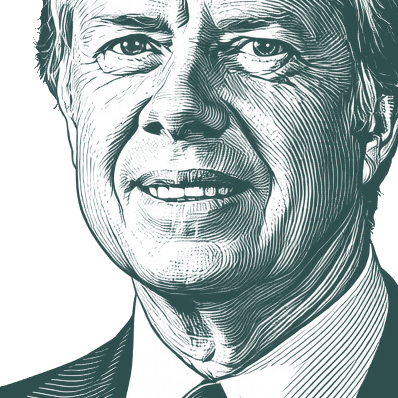
Do you think we are making some progress now? Do you think we have a long way to go? Do you think we are going to get there? Right on. I'm very proud… - Jimmy Carter
""
Do you think we are making some progress now? Do you think we have a long way to go? Do you think we are going to get there? Right on. I'm very proud to be here tonight in what I think is an historic occasion that will perhaps go down in the history of our country as a turning point in the minds and hearts of the American people in their long overdue concern about a large group of Americans, about 36 million, who in the past have too often been ignored. This is the first White House Conference on the Handicapped. I know that this is a tremendous assembly of leaders who have fought a long and sometimes discouraging battle to arrive here in Washington tonight. But this is not the first meeting. There have been dozens and dozens of meetings, attended by thousands of people in the 50 States of our country, and you have already brought to the consciousness of local and State officials an awareness of potential change 'for the better and many improvements that have already been made. Labor, industry can work together with government to make sure that, jointly, our efforts are successful. There is hardly a national leader on Earth in all the 150 nations that span the globe, who are not now thinking about two words: human rights. And now we in our own country are applying those two words to the handicapped people of our country. It's long overdue.
English
Collect this quote
About
Jimmy Carter
James Earl Carter, Jr. (October 1, 1924 – December 29, 2024) was an American politician and member of the Democratic Party who served as the 39th president of the United States from 1977 to 1981. In 1982 he established the Carter Center, as a base for promoting human rights, democracy, finding peaceful solutions to international conflicts, and advancing economic and social development, for which he was awarded the Nobel Peace Prize in 2002. He was a key figure in the Habitat for Humanity project, and has been noted for his criticism of Israel's role in the Israeli–Palestinian conflict.
Biography information from
Wikiquote·
Portrait adapted from
Wikimedia Commons, Department of Defense. Department of the Navy. Naval Photographic Center (Public domain / CC0)
Also Known As
Birth Name:
James Earl Carter Jr.
Alternative Names:
James E. Carter
•
James Carter
•
James Earl Carter
•
39th President of the United States
•
James E. Carter Jr.
•
James Earl Carter, Jr.
•
James E. Carter, Jr.
With massive arsenals still on hair-trigger alert, a global holocaust is just as possible now, through mistakes or misjudgments, as it was during the depths of the Cold War.
The public is not paying attention. That's correct. And this has resulted in an enormous increase in the waste of fuel and also an increase in imports, which seriously unbalances our trade relationships with foreign countries. I just spent some time right before lunch going over the reasons for it. There may be some indication that stockpiling is taking place in anticipation of the wellhead tax being imposed and because of the uncertainty of future price increases by the OPEC nations. But that's a relatively minor factor, although it is a factor. I hope that the Congress will act expeditiously and not weaken the energy legislation, one of its primary purposes being to impose strict conservation measures. But I would say that at this point, the public has not responded well; that the absence of visibility to the impending oil shortage removes the incentive for the public to be concerned. And I'm afraid that a series of crises are going to be a prerequisite to a sincere desire on the part of the American people to quit wasting so much fuel. We've seen this now on two or three occasions already, as a precursor. One, obvious]y, was the natural gas shortage this past winter; another one was the embargo in 1973, the rapid escalation in prices, and now the very severe trade imbalance. I think these are just predictions of what is to come. I'm concerned that the public has not responded well. And I think voluntary compliance is probably not adequate at all. We will take what the Congress does this year and continue to build on it in subsequent years. I'm determined to have a complete and comprehensive energy package on the books before I go out of office. And what we don't get this year, we'll get in subsequent years.
I never considered disobeying an order or even a request from Daddy. I loved and admired him, and one of my preeminent goals in life was to earn his approbation. I learned to expect his criticisms, always constructive, but his accolades were rare.