Limited Time Offer
Premium members can get their quote collection automatically imported into their Quotewise collections.
" "A will whose maxims necessarily coincide with the laws of autonomy is a holy will, good absolutely. The dependence of a will not absolutely good on the principle of autonomy (moral necessitation) is obligation. This, then, cannot be applied to a holy being. The objective necessity of actions from obligation is called duty. From what has just been said, it is easy to see how it happens that, although the conception of duty implies subjection to the law, we yet ascribe a certain dignity and sublimity to the person who fulfills all his duties. There is not, indeed, any sublimity in him, so far as he is subject to the moral law; but inasmuch as in regard to that very law he is likewise a legislator, and on that account alone subject to it, he has sublimity. We have also shown above that neither fear nor inclination, but simply respect for the law, is the spring which can give actions a moral worth.
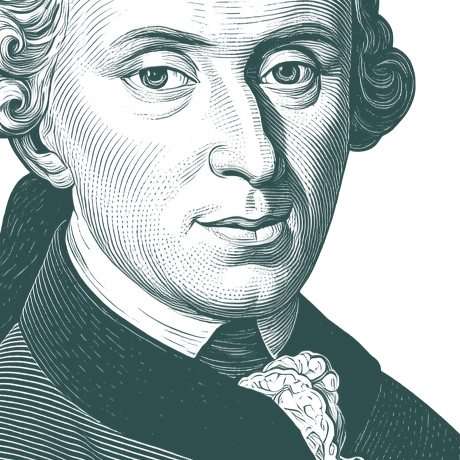
Immanuel Kant (22 April 1724 – 12 February 1804), born Emanuel Kant, was a German philosopher.
Biography information from Wikiquote
Premium members can get their quote collection automatically imported into their Quotewise collections.
Related quotes. More quotes will automatically load as you scroll down, or you can use the load more buttons.
Deficiency in judgement is properly that which is called stupidity; and for such a failing we know no remedy. A dull or narrow-minded person, to whom nothing is wanting but a proper degree of understanding, may be improved by tuition, even so far as to deserve the epithet of learned. But as such persons frequently labour under a deficiency in the faculty of judgement, it is not uncommon to find men extremely learned who in the application of their science betray a lamentable degree this irremediable want.]
Add semantic quote search to your AI assistant via MCP. One command setup.
Without sensibility no object would be given to us, without understanding no object would be thought. Thoughts without content are empty, intuitions without concepts are blind. It is, therefore, just as necessary to make our concepts sensible, that is, to add the object to them in intuition, as to make our intuitions intelligible, that is, to bring them under concepts. These two powers or capacities cannot exchange their functions. The understanding can intuit nothing, the senses can think nothing. Only through their union can knowledge arise. But that is no reason for confounding the contribution of either with that of the other; rather is it a strong reason for carefully separating and distinguishing the one from the other. We therefore distinguish the science of the rules of sensibility in general, that is, aesthetic, from the science of the rules of the understanding in general, that is, logic.