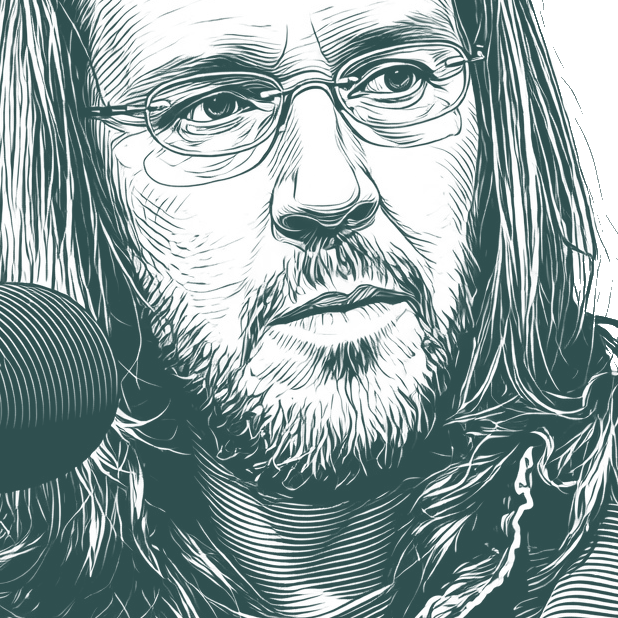
The truth is that the heroism of your childhood entertainments was not true valor. It was theatre. The grand gesture, the moment of choice, the morta… - David Foster Wallace
""
The truth is that the heroism of your childhood entertainments was not true valor. It was theatre. The grand gesture, the moment of choice, the mortal danger, the external foe, the climactic battle whose outcome resolves all — all designed to appear heroic, to excite and gratify and audience. Gentlemen, welcome to the world of reality — there is no audience. No one to applaud, to admire. No one to see you. Do you understand? Here is the truth — actual heroism receives no ovation, entertains no one. No one queues up to see it. No one is interested.
David Foster Wallace (21 February 1962 – 12 September 2008) was an American novelist, essayist, and short story writer. His works include The Broom of the System (novel), Infinite Jest (novel), The Girl With Curious Hair (short story collection), Brief Interviews with Hideous Men (short story collection), A Supposedly Fun Thing I'll Never Do Again (essay collection), and the posthumously-published The Pale King (novel) and Both Flesh and Not (essay collection).
Related quotes. More quotes will automatically load as you scroll down, or you can use the load more buttons.
Shorter versions of this quote
Gentlemen, welcome to the world of reality — there is no audience. No one to applaud, to admire. No one to see you. Do you understand? Here is the truth — actual heroism receives no ovation, entertains no one. No one queues up to see it. No one is interested.
And I submit that this is what the real, no-shit value of your liberal arts education is supposed to be about: How to keep from going through your comfortable, prosperous, respectable adult life dead, unconscious, a slave to your head and to your natural default setting of being uniquely, completely, imperially alone, day in and day out.
And then also, again, still, what are those boundaries, if they’re not baselines, that contain and direct its infinite expansion inward, that make tennis like chess on the run, beautiful and infinitely dense? The true opponent, the enfolding boundary, is the player himself. Always and only the self out there, on court, to be met, fought, brought to the table to hammer out terms. The competing boy on the net’s other side: he is not the foe: he is more the partner in the dance. He is the what is the word excuse or occasion for meeting the self. As you are his occasion. Tennis’s beauty’s infinite roots are self-competitive. You compete with your own limits to transcend the self in imagination and execution. Disappear inside the game: break through limits: transcend: improve: win. Which is why tennis is an essentially tragic enterprise… You seek to vanquish and transcend the limited self whose limits make the game possible in the first place. It is tragic and sad and chaotic and lovely. All life is the same, as citizens of the human State: the animating limits are within, to be killed and mourned, over and over again…Mario thinks hard again. He’s trying to think of how to articulate something like: But then is battling and vanquishing the self the same as destroying yourself? Is that like saying life is pro-death? … And then but so what’s the difference between tennis and suicide, life and death, the game and its own end?
"Literary fiction and poetry are real marginalized right now. There's a fallacy that some of my friends sometimes fall into, the ol' "The audience is stupid. The audience only wants to go this deep. Poor us, we're marginalized because of TV, the great hypnotic blah, blah." You can sit around and have these pity parties for yourself. Of course this is bullshit. If an art form is marginalized it's because it's not speaking to people. One possible reason is that the people it's speaking to have become too stupid to appreciate it. That seems a little easy to me."