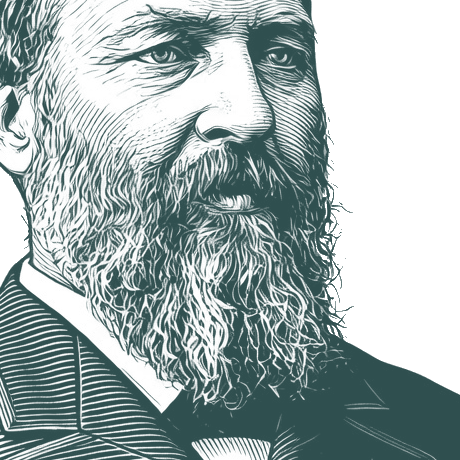
James Abram Garfield (19 November 1831 – 19 September 1881) was the 20th president of the United States of America in 1881, and the second U.S. president to be assassinated. His term was the second shortest in U.S. history, after William Henry Harrison's. Holding office from March to September of 1881, President Garfield was in office for a total of just six months and fifteen days. A Republican, he supported civil rights and freedoms for African Americans.
Biography information from
Wikiquote·
Portrait adapted from
Wikimedia Commons, Unknown; part of Brady-Handy Photograph Collection. (Public domain / CC0)
Also Known As
Birth Name:
James Abram Garfield
Alternative Names:
James Garfield
•
J. A. Garfield
•
J. Garfield
•
President Garfield
Portrait from Wikimedia Commons. Credit: Unknown; part of Brady-Handy Photograph Collection.. Used under Public domain / CC0. Processed and styled by Quotewise.
Try QuoteGPT
Chat naturally about what you need. Each answer links back to real quotes with citations.
Related quotes. More quotes will automatically load as you scroll down, or you can use the load more buttons.
Garfield: "Old boy! Do you think my name will have a place in human history?" Rockwell: "Yes, a grand one, but a grander one in human hearts. Old fellow, you mustn’t talk in that way. You have a great work yet to perform." Garfield: "No. My work is done."
My countrymen, we do not now differ in our judgment concerning the controversies of past generations, and fifty years hence our children will not be divided in their opinions concerning our controversies. They will surely bless their fathers and their fathers' God that the Union was preserved, that slavery was overthrown, and that both races were made equal before the law. We may hasten or we may retard, but we can not prevent, the final reconciliation.
Works in ChatGPT, Claude, or Any AI
Add semantic quote search to your AI assistant via MCP. One command setup.
But liberty is no negation. It is a substantive, tangible reality. It is the realization of those imperishable truths of the Declaration 'that all men are created equal', that the sanction of all just government is 'the consent of the governed'. Can these truths be realized until each man has a right be to heard on all matters relating to himself?