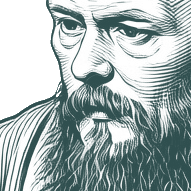
Fyodor Mikhailovich Dostoyevsky or Dostoevsky [Фёдор Миха́йлович Достое́вский] (11 November 1821 - 9 February 1881) was a Russian novelist, short story writer, essayist, and journalist. Dostoevsky's literary works explore the human condition in the troubled political, social, and spiritual atmospheres of 19th-century Russia, and engage with a variety of philosophical and religious themes. Many literary critics rate him as one of the greatest novelists in all of world literature, as multiple of his works are considered highly influential masterpieces.
Biography information from
Wikiquote·
Portrait adapted from
Wikimedia Commons, Vasily Perov (Public domain / CC0)
Also Known As
Pen Names:
Д.
•
Друг Кузьмы Пруткова
•
Зубоскал
•
—ий
•
М.
•
Летописец
•
М-ий
•
Н. Н.
•
Пружинин
•
Зубоскалов
•
Ред.
•
Ф. Д.
•
N.N.
To be acutely conscious is a disease, a real, honest-to-goodness disease.
Love is such a priceless treasure that you can buy the whole world with it, and redeem not only your own but other people's sins. Go, and do not be afraid.
PREMIUM FEATURE
Advanced Search Filters
Filter search results by source, date, and more with our premium search tools.
A great many people were put down as mad among us last year. And in such language! "With such original talent" ... "and yet, after all, it appears" ... "however, one ought to have foreseen it long ago." That is rather artful; so that from the point of view of pure art one may really commend it. Well, but after all, these so-called madmen have turned out cleverer than ever. So it seems the critics can call them mad, but they cannot produce any one better. The wisest of all, in my opinion, is he who can, if only once a month, call himself a fool — a faculty unheard of nowadays. In old days, once a year at any rate a fool would recognise that he was a fool, but nowadays not a bit of it. And they have so muddled things up that there is no telling a fool from a wise man. They have done that on purpose. I remember a witty Spaniard saying when, two hundred and fifty years ago, the French built their first madhouses: "They have shut up all their fools in a house apart, to make sure that they are wise men themselves." Just so: you don't show your own wisdom by shutting some one else in a madhouse. "K. has gone out of his mind, means that we are sane now." No, it doesn't mean that yet.