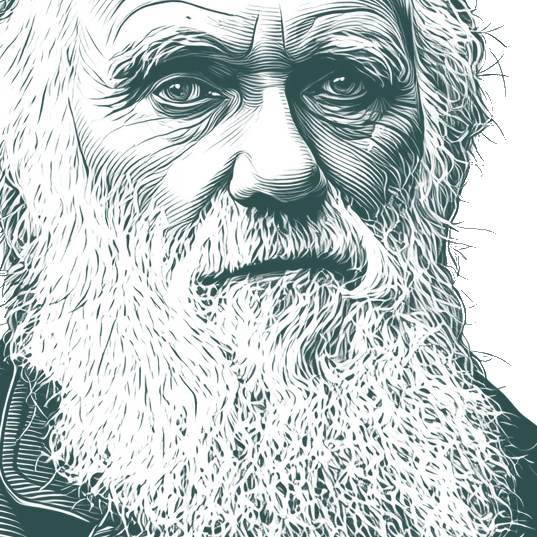
Charles Robert Darwin (12 February 1809 – 19 April 1882) was an English naturalist, geologist and biologist, best known for his contributions to the science of evolution. He proposed that evolution could be explained in part through natural and sexual selection. Prompted by awareness that Alfred Russel Wallace was developing similar theories he published his own sooner than he had originally intended. This theory is now an integral component of biological science.
Biography information from
Wikiquote·
Portrait adapted from
Wikimedia Commons, Herbert Rose Barraud (Public domain / CC0)
Also Known As
Birth Name:
Charles Robert Darwin
Alternative Names:
Charles R. Darwin
•
C. R. Darwin
•
Darwin
•
C.R. Darwin
•
CR Darwin
I have attempted to show that the geological record is extremely imperfect; that only a small portion of the globe has been geologically explored with care; that only certain classes of organic beings have been largely preserved in a fossil state; that the number both of specimens and of species, preserved in our museums, is absolutely as nothing compared with the incalculable number of generations which must have passed away even during a single formation; that, owing to subsidence being necessary for the accumulation of fossiliferous deposits thick enough to resist future degradation, enormous intervals of time have elapsed between the successive formations; that there has probably been more extinction during the periods of subsidence, and more variation during the periods of elevation, and during the latter the record will have been least perfectly kept; that each single formation has not been continuously deposited; that the duration of each formation is, perhaps, short compared with the average duration of specific forms; that migration has played an important part in the first appearance of new forms in any one area and formation; that widely ranging species are those which have varied most, and have oftenest given rise to new species; and that varieties have at first often been local (emphasis not Darwin's). All these causes taken conjointly, must have tended to make the geological record extremely imperfect, and will to a large extent explain why we do not find interminable varieties, connecting together all the extinct and existing forms of life by the finest graduated steps. He who rejects these views on the nature of the geological record, will rightly reject my whole theory. For he may ask in vain where are the numberless transitional links which must formerly have connected the closely allied or representative species, found in the several stages of the same great formation. He may disbelieve in the enormous intervals of time which have elapsed between our consecutive formations; he may overlook how important a part migration must have played, when the formations of any one great region alone, as that of Europe, are considered; he may urge the apparent, but often falsely apparent, sudden coming in of whole groups of species. He may ask where are the remains of those infinitely numerous organisms which must have existed long before the first bed of the Silurian system was deposited: I can answer this latter question only hypothetically, by saying that as far as we can see, where our oceans now extend they have for an enormous period extended, and where our oscillating continents now stand they have stood ever since the Silurian epoch; but that long before that period, the world may have presented a wholly different aspect; and that the older continents, formed of formations older than any known to us, may now all be in a metamorphosed condition, or may lie buried under the ocean.
Thus, from the war of nature, from famine and death, the most exalted object which we are capable of conceiving, namely, the production of the higher animals, directly follows. There is grandeur in this view of life, with its several powers, having been originally breathed into a few forms or into one; and that, whilst this planet has gone cycling on according to the fixed law of gravity, from so simple a beginning endless forms most beautiful and most wonderful have been, and are being, evolved.
Go Premium
Support Quotewise while enjoying an ad-free experience and premium features.
Look at a plant in the midst of its range! Why does it not double or quadruple its numbers? We know that it can perfectly well withstand a little more heat or cold, dampness or dryness, for elsewhere it ranges into slightly hotter or colder, damper or drier districts. In this case we can clearly see that if we wish in imagination to give the plant the power of increasing in numbers, we should have to give it some advantage