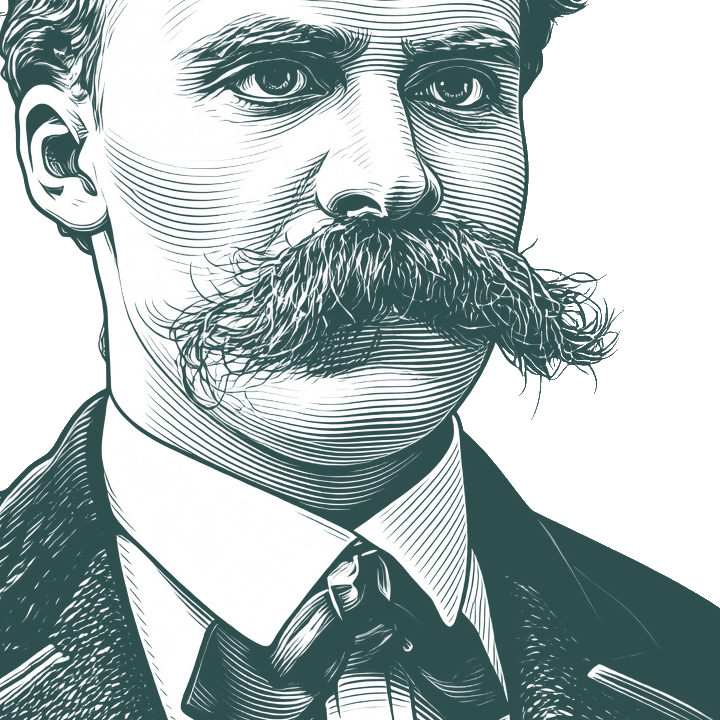
He has heart who knows fear, but vanquishes it; who sees the abyss, but with pride.
He who sees the abyss, but with eagle's eyes,- he who with eagle'… - Friedrich Nietzsche
""
He has heart who knows fear, but vanquishes it; who sees the abyss, but with pride. He who sees the abyss, but with eagle's eyes,- he who with eagle's talons grasps the abyss: he has courage.
English
Collect this quote
About
Friedrich Nietzsche
Friedrich Wilhelm Nietzsche (15 October 1844 – 25 August 1900) was a German philosopher, cultural critic, composer, poet, writer, and philologist whose work has exerted a profound influence on modern intellectual history. His critiques of contemporary culture, religion, and philosophy centered on a basic question regarding the foundation of values and morality.
Biography information from
Wikiquote·
Portrait adapted from
Wikimedia Commons, Friedrich Hermann Hartmann (Public domain / CC0)
Also Known As
Alternative Names:
Friedrich Wilhelm Nietzsche
•
Nietzsche
Only by means of such discipline can the young man acquire that physical loathing for the beloved and much-admired 'elegance' of style of our newspaper manufacturers and novelists, and for the 'ornate style' of our literary men; by it alone is he irrevocably elevated at a stroke above a whole host of absurd questions and scruples, such, for instance, as whether Auerbach and Gutzkow are really poets, for his disgust at both will be so great that he will be unable to read them any longer, and thus the problem will be solved for him. Let no one imagine that it is an easy matter to develop this feeling to the extent necessary in order to have this physical loathing; but let no one hope to reach sound æsthetic judgments along any other road than the thorny one of language, and by this I do not mean philological research, but self-discipline in one's mother-tongue. Everybody who is in earnest in this matter will have the same sort of experience as the recruit in the army who is compelled to learn walking after having walked almost all his life as a dilettante or empiricist. It is a hard time: one almost fears that the tendons are going to snap and one ceases to hope that the artificial and consciously acquired movements and positions of the feet will ever be carried out with ease and comfort. It is painful to see how awkwardly and heavily one foot is set before the other, and one dreads that one may not only be unable to learn the new way of walking, but that one will forget how to walk at all. Then it suddenly become noticeable that a new habit and a second nature have been born of the practised movements, and that the assurance and strength of the old manner of walking returns with a little more grace: at this point one begins to realise how difficult walking is, and one feels in a position to laugh at the untrained empiricist or the elegant dilettante. Our 'elegant' writers, as their style shows, have never learnt 'walking' in this sense, and in our public schools, as our other writers show, no one learns walking either. Culture begins, however, with the correct movement of the language: and once it has properly begun, it begets that physical sensation in the presence of 'elegant' writers which is known by the name of 'loathing.'
One must have a good memory to be able to keep the promises one has given. One must have strong powers of imagination to be able to have pity. So closely is morality bound to the quality of the intellect.
Limited Time Offer
Premium members can get their quote collection automatically imported into their Quotewise collections.
Man has an invincible inclination to allow himself to be deceived and is, as it were, enchanted with happiness when the rhapsodist tells him epic fables as if they were true, or when the actor in the theater acts more royally than any real king. So long as it is able to deceive without injuring, that master of deception, the intellect, is free; it is released from its former slavery and celebrates its Saturnalia. It is never more luxuriant, richer, prouder, more clever and more daring.