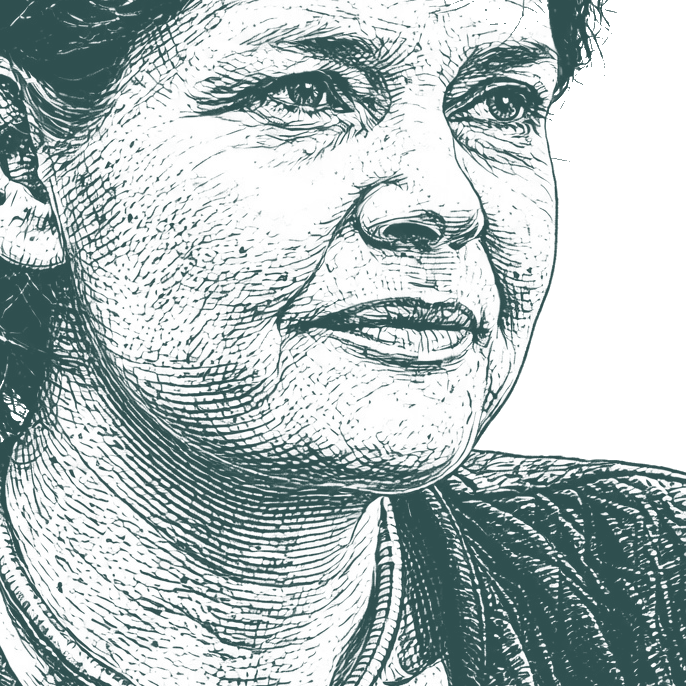
Around 40 percent of the world’s agricultural land is now seriously degraded, and by 2025 two out of three people worldwide will live in water-stress… - Kate Raworth
""
Around 40 percent of the world’s agricultural land is now seriously degraded, and by 2025 two out of three people worldwide will live in water-stressed regions.
English
Collect this quote
About
Kate Raworth
Kate Raworth (1970-) is an English economist, known for her 'doughnut economics' model balancing between essential human needs and planetary boundaries.
What if every company strategised around a Doughnut table, asking itself: is our brand a Doughnut brand, whose core business helps to bring humanity into that safe and just space? Imagine if the G20 finance ministers — representing the world’s most powerful economies — met around a Doughnut-shaped conference table to discuss how to design a global financial system that served to bring humanity into that sweet spot. These would be world-changing conversations.
argues the evolutionary psychologist Gerd Gigerenzer: we have survived and thrived not despite our cognitive biases but because of them. These so-called biases are the underpinnings of our heuristics, the unconscious mental shortcuts we take every time we use a ‘rule of thumb’ to make decisions. Over millennia, the human brain has evolved to rely on quick decision-making tools in a fast-moving and uncertain world, and in many contexts those heuristics lead us to make better decisions than exact calculations would do.
Unlimited Quote Collections
Organize your favorite quotes without limits. Create themed collections for every occasion with Premium.
Despite their current rhetoric of ‘free trade’, when it comes to trade negotiations almost all of today’s high-income countries — including the UK and the United States — took the opposite route to ensure their own industrial success, opting for tariff protection, industrial subsidies and state-owned enterprises when it was nationally advantageous. And today they still keep tight control over their key traded assets such as intellectual property.