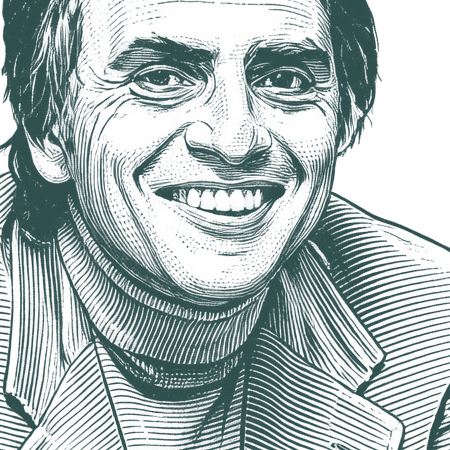
I often am asked, ''Do you believe in UFOs?'' I'm always struck by how the question is phrased, the suggestion that this is a matter of belief and no… - Carl Sagan
""
I often am asked, ''Do you believe in UFOs?'' I'm always struck by how the question is phrased, the suggestion that this is a matter of belief and not of evidence. I'm almost never asked, ''How good is the evidence that UFOs are alien spaceships?
Carl Edward Sagan (9 November 1934 – 20 December 1996) was an American astronomer, planetary scientist, cosmologist, astrophysicist, astrobiologist, author, and science communicator. His best known scientific contribution is research on extraterrestrial life, including experimental demonstration of the production of amino acids from basic chemicals by radiation. Sagan assembled the first physical messages sent into space, the Pioneer plaque and the Voyager Golden Record, universal messages that could potentially be understood by any extraterrestrial intelligence that might find them. Sagan argued the hypothesis, accepted since, that the high surface temperatures of Venus can be attributed to, and calculated using, the greenhouse effect. He testified to the US Congress in 1985 that the greenhouse effect will change the earth's climate system.
Biography information from
Wikiquote·
Portrait adapted from
Wikimedia Commons, NASA/JPL (Public domain / CC0)
Also Known As
Native Name:
Carl Edward Sagan
Alternative Names:
Sagan
•
Carl E. Sagan
•
Carl E Sagan
•
C. E. Sagan
•
C.E. Sagan
•
C E Sagan
•
C. Sagan
•
C Sagan
•
Sagan C
•
Sagan C.
•
Sagan C. E.
•
Sagan CE
Because science carries us toward an understanding of how the world is, rather than how we would wish it to be, its findings may not in all cases be immediately comprehensible or satisfying. It may take a little work to restructure our mindsets. Some of science is very simple. When it gets complicated, that’s usually because the world is complicated — or because we’re complicated.
I wish to propose a doctrine which may, I fear, appear wildly paradoxical and subversive. The doctrine in question is this: that it is undesirable to believe a proposition when there is no ground whatever for supposing it true. I must, of course, admit that if such an opinion became common it would completely transform our social life and our political system; since both are at present faultless, this must weigh against it.
Indeed, much of Newton’s intellectual development can be attributed to this tension between rationalism and mysticism. At the Stourbridge Fair in 1663, at age twenty, he purchased a book on astrology, ‘out of a curiosity to see what there was in it.’ He read it until he came to an illustration which he could not understand, because he was ignorant of trigonometry. So he purchased a book on trigonometry but soon found himself unable to follow the geometrical arguments. So he found a copy of Euclid’s Elements of Geometry, and began to read. Two years later he invented the differential calculus.