Throughout human history, societies have grappled with fundamental questions of how to organize themselves, the proper relationship between the indiv… - Barack Obama
""
Throughout human history, societies have grappled with fundamental questions of how to organize themselves, the proper relationship between the individual and the state, the best means to resolve inevitable conflicts between states. And it was here in Europe, through centuries of struggle -- through war and Enlightenment, repression and revolution -- that a particular set of ideals began to emerge: The belief that through conscience and free will, each of us has the right to live as we choose. The belief that power is derived from the consent of the governed, and that laws and institutions should be established to protect that understanding. And those ideas eventually inspired a band of colonialists across an ocean, and they wrote them into the founding documents that still guide America today, including the simple truth that all men -- and women -- are created equal. But those ideals have also been tested -- here in Europe and around the world. Those ideals have often been threatened by an older, more traditional view of power. This alternative vision argues that ordinary men and women are too small-minded to govern their own affairs, that order and progress can only come when individuals surrender their rights to an all-powerful sovereign. Often, this alternative vision roots itself in the notion that by virtue of race or faith or ethnicity, some are inherently superior to others, and that individual identity must be defined by “us” versus “them,” or that national greatness must flow not by what a people stand for, but by what they are against. In many ways, the history of Europe in the 20th century represented the ongoing clash of these two sets of ideas, both within nations and among nations. The advance of industry and technology outpaced our ability to resolve our differences peacefully, and even among the most civilized of societies, on the surface we saw a descent into barbarism.
English
Collect this quote
About
Barack Obama
Barack Hussein Obama II (born August 4, 1961) is an American politician who served as the 44th president of the United States of America from 2009 to 2017. Born in Hawaii, the son of a Kenyan father and a mother from Kansas, he won the 2008 presidential election and was re-elected president in November 2012. A member of the U.S. Democratic Party, he was the first African American president. Before becoming president, he represented the 13th district for three terms in the Illinois Senate from 1997 to 2004 and served as United States senator from Illinois between January 4, 2005 and November 16, 2008. While president, he was the recipient of the 2009 Nobel Peace Prize.
Biography information from
Wikiquote·
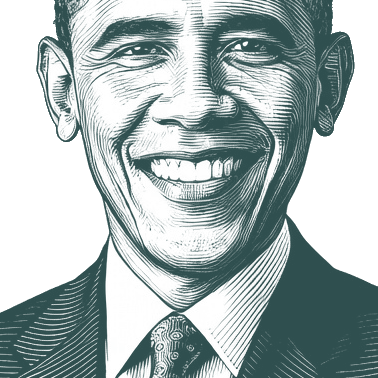
Portrait adapted from
Wikimedia Commons, Official White House Photo by Pete Souza (Public domain / CC0)
Also Known As
Birth Name:
Barack Hussein Obama II
Also Known As:Barry
Alternative Names:
POTUS 44
•
Barack Hussein Obama
•
Barack H. Obama
•
Barack Hussein Obama, Jr.
•
Barack H Obama
•
Barak Obama
•
Barry Obama
•
Barack Obama II
Whatever you do won’t be enough, I heard their voices say. Try anyway.
No, the reward comes in knowing that our entire way of life in America depends on the rule of law; that the maintenance of that law is a hard and daily labor; that in this country, we don’t have soldiers in the streets or militias setting the rules. Instead, we have public servants -- police officers -- like the men who were taken away from us.
Works in ChatGPT, Claude, or Any AI
Add semantic quote search to your AI assistant via MCP. One command setup.