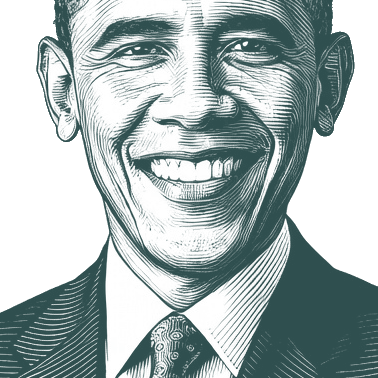
And so the moment we persuade a child, any child, to cross that threshold into a library, we've changed their lives forever, and for the better. This… - Barack Obama
""
And so the moment we persuade a child, any child, to cross that threshold into a library, we've changed their lives forever, and for the better. This is an enormous force for good.
English
Collect this quote
About
Barack Obama
Barack Hussein Obama II (born August 4, 1961) is an American politician who served as the 44th president of the United States of America from 2009 to 2017. Born in Hawaii, the son of a Kenyan father and a mother from Kansas, he won the 2008 presidential election and was re-elected president in November 2012. A member of the U.S. Democratic Party, he was the first African American president. Before becoming president, he represented the 13th district for three terms in the Illinois Senate from 1997 to 2004 and served as United States senator from Illinois between January 4, 2005 and November 16, 2008. While president, he was the recipient of the 2009 Nobel Peace Prize.
Biography information from
Wikiquote·
Portrait adapted from
Wikimedia Commons, Official White House Photo by Pete Souza (Public domain / CC0)
Also Known As
Birth Name:
Barack Hussein Obama II
Also Known As:Barry
Alternative Names:
POTUS 44
•
Barack Hussein Obama
•
Barack H. Obama
•
Barack Hussein Obama, Jr.
•
Barack H Obama
•
Barak Obama
•
Barry Obama
•
Barack Obama II
Related quotes. More quotes will automatically load as you scroll down, or you can use the load more buttons.
Shorter versions of this quote
At the moment that we persuade a child, any child, to cross that threshold, that magic threshold into a library, we change their lives forever, for the better
The March on Washington teaches us that we are not trapped by the mistakes of history; that we are masters of our fate. But it also teaches us that the promise of this nation will only be kept when we work together. We’ll have to reignite the embers of empathy and fellow feeling, the coalition of conscience that found expression in this place 50 years ago. And I believe that spirit is there, that truth force inside each of us. I see it when a white mother recognizes her own daughter in the face of a poor black child. I see it when the black youth thinks of his own grandfather in the dignified steps of an elderly white man. It’s there when the native-born recognizing that striving spirit of the new immigrant; when the interracial couple connects the pain of a gay couple who are discriminated against and understands it as their own. That’s where courage comes from -- when we turn not from each other, or on each other, but towards one another, and we find that we do not walk alone. That’s where courage comes from.
There's been a trend around the country of trying to get college to disinvite speakers with a different point of view or disrupt a politician's rally. Don't do that, no matter how ridiculous or offensive you might find the things that come out of their mouths... If the other side has a point, learn from them! If they're wrong, rebut them, teach them, beat them on the battlefield of ideas!
Go Premium
Support Quotewise while enjoying an ad-free experience and premium features.