The idea that the people have a right to choose their own rulers was not new in political history. It was the foundation of every popular attempt to … - Calvin Coolidge
""
The idea that the people have a right to choose their own rulers was not new in political history. It was the foundation of every popular attempt to depose an undesirable king. This right was set out with a good deal of detail by the Dutch when as early as July 26, 1581, they declared their independence of Philip of Spain. In their long struggle with the Stuarts the British people asserted the same principles, which finally culminated in the Bill of Rights deposing the last of that house and placing William and Mary on the throne. In each of these cases sovereignty through divine right was displaced by sovereignty through the consent of the people. Running through the same documents, though expressed in different terms, is the clear inference of inalienable rights. But we should search these charters in vain for an assertion of the doctrine of equality. This principle had not before appeared as an official political declaration of any nation. It was profoundly revolutionary. It is one of the corner stones of American institutions.
John Calvin Coolidge Jr. (4 July 1872 – 5 January 1933) was the 30th president of the United States (1923–29). A Republican lawyer from Vermont, Coolidge worked his way up the ladder of Massachusetts state politics, eventually becoming governor of that state. His response to the Boston Police Strike of 1919 thrust him into the national spotlight and gave him a reputation as a man of decisive action. Soon after, he was elected as the 29th vice president in 1920 and succeeded to the presidency upon the sudden death of Warren G. Harding in 1923. Elected in his own right in 1924, he gained a reputation as a small-government conservative.
Biography information from
Wikiquote·
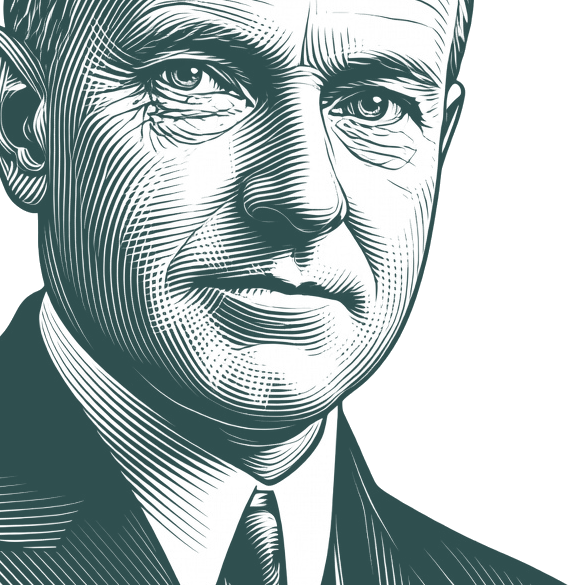
Portrait adapted from
Wikimedia Commons, Harris & Ewing (Public domain / CC0)
Also Known As
Birth Name:
John Calvin
Alternative Names:
John Calvin Coolidge Jr.
•
John Calvin Coolidge
•
President Coolidge
•
J. C. Coolidge
•
C. Coolidge
•
Silent Cal
•
Silent Cal Coolidge
To meet these necessities the Government has been developing a water power project at Muscle Shoals to be equipped to produce nitrogen for explosives and fertilizer. It is my opinion that the support of agriculture is the chief problem to consider in connection with this property. It could by no means supply the present needs for nitrogen, but it would help and its development would encourage bringing other water powers into like use.
Shipping board. The form of the organization of the Shipping Board was based originally on its functions as a semi judicial body in regulation of rates. During the war it was loaded with enormous administrative duties. It has been demonstrated time and again that this form of organization results in indecision, division of opinion and administrative functions, which make a wholly inadequate foundation for the conduct of a great business enterprise. The first principle in securing the objective set out by Congress in building up the American merchant marine upon the great trade routes and subsequently disposing of it into private operation can not proceed with effectiveness until the entire functions of the board are reorganized. The immediate requirement is to transfer into the Emergency Fleet, Corporation the whole responsibility of operation of the fleet and other property, leaving to the Shipping Board solely the duty of determining certain major policies which require deliberative action.
Go Premium
Support Quotewise while enjoying an ad-free experience and premium features.
Under the attempt to perform the impossible there sets in a general disintegration. When legislation fails, those who look upon it as a sovereign remedy simply cry out for more legislation.
A sound and wise statesmanship which recognizes and attempts to abide by its limitations will undoubtedly find itself displaced by that type of public official who promises much, talks much, legislates much, expends much, but accomplishes little.
The deliberate, sound judgement of the country is likely to find it has been superseded by a popular whim.