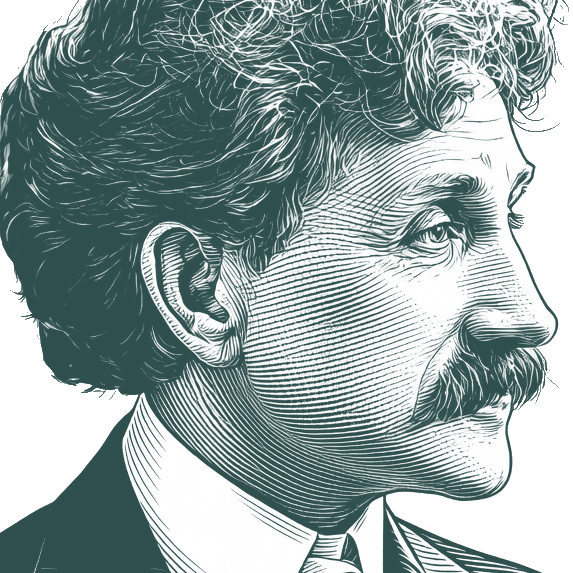
I became a vegetarian by my own reflection. I did not know at the time of the vegetarian movement, and hence, supposed myself among republics of carn… - J. Howard Moore
""
I became a vegetarian by my own reflection. I did not know at the time of the vegetarian movement, and hence, supposed myself among republics of carnivora. It did not seem to me graceful or ideal that I, an ethical being should maintain my existence at the incessant expense of misery and death to others.
English
Collect this quote
About
J. Howard Moore
John Howard Moore (December 4, 1862 – June 17, 1916) was an American zoologist, philosopher, educator and social reformer. He advocated for the ethical consideration and treatment of animals and authored several articles, books, essays and pamphlets on topics including education, ethics, evolutionary biology, humanitarianism, utilitarianism and vegetarianism. He is best known for his work The Universal Kinship (1906), which advocated for a secular sentiocentric philosophy he called the doctrine of "Universal Kinship", based on the shared evolutionary kinship between all sentient beings.
Look at human industry! See the pounds of flesh daily torn by men everywhere from the skeletons of each other in the awful riot of <nowiki>''</nowiki>business." Just look at it! The inequity, the unconsciousness, the hard-heartedness, the ruffianism, and the infernalism of the industrial relations and conditions of men! Watch an unfortunate approach a rich man's mansion and ask in the most graceful manner for a necessary of life. Observe the egoism the baron shows as he sends the sufferer away unfed. See the lord in his marble palace, upholstered with all the comforts of civilization and stuffed with the dainties of the zones, and around him the men and women who made his wealth feeding on garbage, suffocating in shanties, and working like wretches from morning till night. See the multi-millionaire, scraping the palms of his slaves till the blood starts for the last farthing their struggles have produced, not because he is hungry and would buy, but because he is a ruffian and can. No attention whatever is paid to the fact that some have all they can utilize in the satisfaction of their desires and multiples more, while others just as good-looking and more worthy have nothing. No attention is paid to the fact that this little pill of a world is to man the only accessible portion of the universe; that he is cut off from other balls by leagues of impassable space.
Let us be true to our ideals, true to the spirit of Universal Compassion—whether we walk with the lone worm wandering in the twilight of consciousness, the feathered forms of the fields and forests, the kine of the meadows, the simple savage on the banks of the gladed river, the political blanks whom men call wives, or the outcasts of human industry.
Enhance Your Quote Experience
Enjoy ad-free browsing, unlimited collections, and advanced search features with Premium.
There is, in fact, but one great crime in the universe, and most of the instances of terrestrial wrong-doing are instances of this crime. It is the crime of exploitation—the considering by some beings of themselves as ends, and of others as their means—the refusal to recognize the equal, or the approximately equal, rights of all to life and its legitimate rewards—the crime of acting toward others as one would that others would not act toward him. For millions of years, almost ever since life began, this crime has been committed, in every nook and quarter of the inhabited globe.