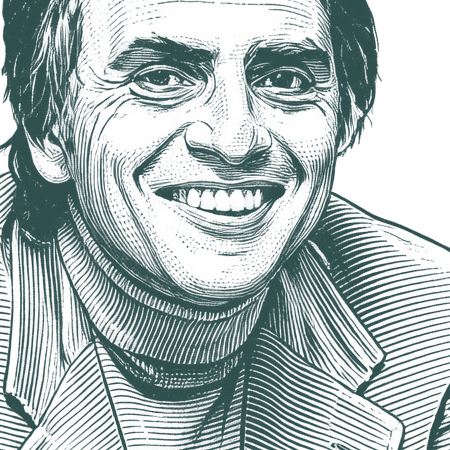
«بينما يُنظر إلى القليل من العلماء على أنهم دخلاء ينتقدون بجسارة أدواء المجتمع، ويقدمون تحذيرات مبكرة من الكوارث التكنولوجية المحتملة؛ فإن الكثيرين ين… - Carl Sagan
""
«بينما يُنظر إلى القليل من العلماء على أنهم دخلاء ينتقدون بجسارة أدواء المجتمع، ويقدمون تحذيرات مبكرة من الكوارث التكنولوجية المحتملة؛ فإن الكثيرين ينظر إليهم باعتبارهم انتهازيين خانعين أو باعتبارهم المصدر الطيع للأرباح المكدسة وأسلحة الدمار الشامل من دون أن يُلقوا بالًا للعواقب طويلة المدى. وتُعتبر الأخطار التكنولوجية التي يقدمها لنا العلم، وكذلك تحديه الضمني للحكمة المنقولة إلينا ممن سبقونا وما ندركه من صعوبة في تناول العلم، كلها أسباب تحدو ببعض الناس إلى عدم الثقة في العلم، والتكنولوجيا.»
Carl Edward Sagan (9 November 1934 – 20 December 1996) was an American astronomer, planetary scientist, cosmologist, astrophysicist, astrobiologist, author, and science communicator. His best known scientific contribution is research on extraterrestrial life, including experimental demonstration of the production of amino acids from basic chemicals by radiation. Sagan assembled the first physical messages sent into space, the Pioneer plaque and the Voyager Golden Record, universal messages that could potentially be understood by any extraterrestrial intelligence that might find them. Sagan argued the hypothesis, accepted since, that the high surface temperatures of Venus can be attributed to, and calculated using, the greenhouse effect. He testified to the US Congress in 1985 that the greenhouse effect will change the earth's climate system.
Biography information from
Wikiquote·
Portrait adapted from
Wikimedia Commons, NASA/JPL (Public domain / CC0)
Also Known As
Native Name:
Carl Edward Sagan
Alternative Names:
Sagan
•
Carl E. Sagan
•
Carl E Sagan
•
C. E. Sagan
•
C.E. Sagan
•
C E Sagan
•
C. Sagan
•
C Sagan
•
Sagan C
•
Sagan C.
•
Sagan C. E.
•
Sagan CE
Keeping an open mind is a virtue — but, as the space engineer James Oberg once said, not so open that your brains fall out.
My view is that if there is no evidence for it, then forget about it. An agnostic is somebody who doesn’t believe in something until there is evidence for it, so I’m agnostic.
...most scientists feel it's not their job to expose pseudoscientific bamboozles - much less, passionately held self-deceptions. They tend not to be very good at it either. Scientists are used to struggling with Nature, who may surrender her secrets reluctantly but who fights fair.