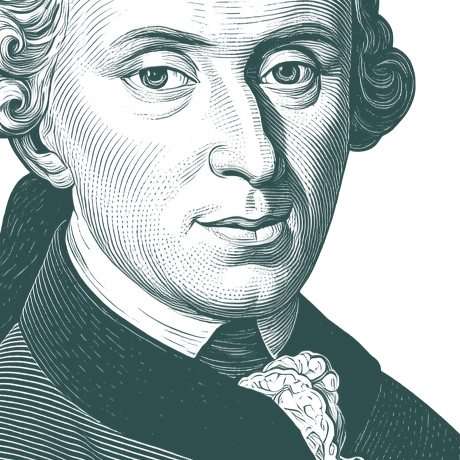
Dogmatism is thus the dogmatic procedure of pure reason without previous criticism of its own powers, and in opposing this procedure, we must not be … - Immanuel Kant
""
Dogmatism is thus the dogmatic procedure of pure reason without previous criticism of its own powers, and in opposing this procedure, we must not be supposed to lend any countenance to that loquacious shallowness which arrogates to itself the name of popularity, nor
Without sensibility no object would be given to us, without understanding no object would be thought. Thoughts without content are empty, intuitions without concepts are blind. It is, therefore, just as necessary to make our concepts sensible, that is, to add the object to them in intuition, as to make our intuitions intelligible, that is, to bring them under concepts. These two powers or capacities cannot exchange their functions. The understanding can intuit nothing, the senses can think nothing. Only through their union can knowledge arise. But that is no reason for confounding the contribution of either with that of the other; rather is it a strong reason for carefully separating and distinguishing the one from the other. We therefore distinguish the science of the rules of sensibility in general, that is, aesthetic, from the science of the rules of the understanding in general, that is, logic.
The whole interest of my reason, whether speculative or practical, is concentrated in the three following questions: What can I know? What should I do? What may I hope? (Critique of Pure Reason
Works in ChatGPT, Claude, or Any AI
Add semantic quote search to your AI assistant via MCP. One command setup.
To behold virtue in her proper form is nothing else but to contemplate morality stripped of all admixture of sensible things and of every spurious ornament of reward or self-love. How much she then eclipses everything else that appears charming to the affections, every one may readily perceive with the least exertion of his reason, if it be not wholly spoiled for abstraction.