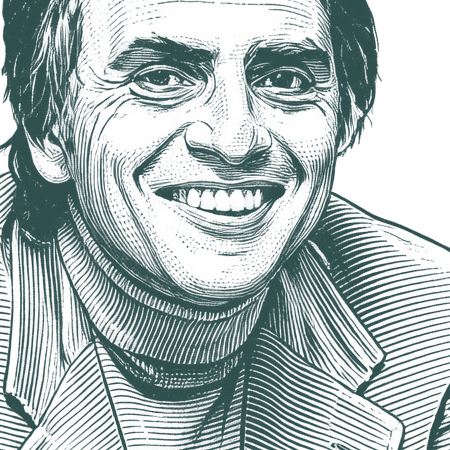
But the universe, all of it, almost everywhere, is 99 percent hydrogen and helium,* the two simplest elements. Helium, in fact, was detected on the S… - Carl Sagan
""
But the universe, all of it, almost everywhere, is 99 percent hydrogen and helium,* the two simplest elements. Helium, in fact, was detected on the Sun before it was found on the Earth — hence its name (from Helios, one of the Greek sun gods). Might the other chemical elements have somehow evolved from hydrogen and helium? To balance the electrical repulsion, pieces of nuclear matter would have to be brought very close together so that the short-range nuclear forces are engaged. This can happen only at very high temperatures where the particles are moving so fast that the repulsive force does not have time to act — temperatures of tens of millions of degrees. In nature, such high temperatures and attendant high pressures are common only in the insides of the stars.
Carl Edward Sagan (9 November 1934 – 20 December 1996) was an American astronomer, planetary scientist, cosmologist, astrophysicist, astrobiologist, author, and science communicator. His best known scientific contribution is research on extraterrestrial life, including experimental demonstration of the production of amino acids from basic chemicals by radiation. Sagan assembled the first physical messages sent into space, the Pioneer plaque and the Voyager Golden Record, universal messages that could potentially be understood by any extraterrestrial intelligence that might find them. Sagan argued the hypothesis, accepted since, that the high surface temperatures of Venus can be attributed to, and calculated using, the greenhouse effect. He testified to the US Congress in 1985 that the greenhouse effect will change the earth's climate system.
Biography information from
Wikiquote·
Portrait adapted from
Wikimedia Commons, NASA/JPL (Public domain / CC0)
Also Known As
Native Name:
Carl Edward Sagan
Alternative Names:
Sagan
•
Carl E. Sagan
•
Carl E Sagan
•
C. E. Sagan
•
C.E. Sagan
•
C E Sagan
•
C. Sagan
•
C Sagan
•
Sagan C
•
Sagan C.
•
Sagan C. E.
•
Sagan CE
Да поддържаш съзнанието си отворено, е добродетел, но — както веднъж каза космическият инженер Джеймс Оубърг — трябва да не е много отворено, за да не ти изпадне мозъкът.
Lo único que pide la ciencia es que se apliquen los mismos niveles de escepticismo que al comprar un coche usado o al juzgar la calidad de un analgésico o una cerveza a través de los anuncios de la televisión.
Unlimited Quote Collections
Organize your favorite quotes without limits. Create themed collections for every occasion with Premium.