It is at this point that my own solution begins to appear. I offer the oddly-named thing pragmatism as a philosophy that can satisfy both kinds of de… - William James
""
It is at this point that my own solution begins to appear. I offer the oddly-named thing pragmatism as a philosophy that can satisfy both kinds of demand. It can remain religious like the rationalisms, but at the same time, like the empiricisms, it can preserve the richest intimacy with facts. I hope I may be able to leave many of you with as favorable an opinion of it as I preserve myself. Yet, as I am near the end of my hour, I will not introduce pragmatism bodily now.
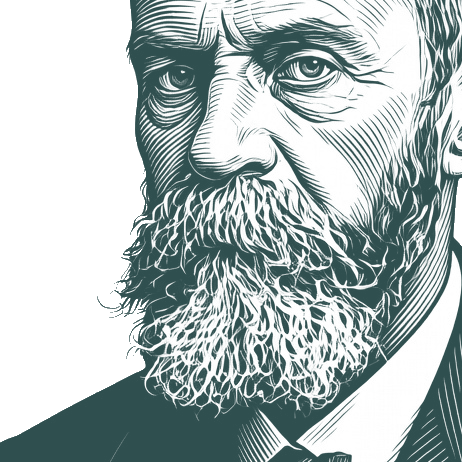
William James (11 January 1842 – 26 August 1910) was a pioneering American psychologist and philosopher. He developed the philosophical perspective known as radical empiricism, and wrote influential books on the science of psychology, the psychology of religious experience and mysticism, and the philosophy of pragmatism.
Biography information from
Wikiquote·
Portrait adapted from
Wikimedia Commons, Alice Boughton (Public domain / CC0)
Since, however, darwinism has once for all displaced design from the minds of the 'scientific,' theism has lost that foothold; and some kind of an immanent or pantheistic deity working IN things rather than above them is, if any, the kind recommended to our contemporary imagination. Aspirants to a philosophic religion turn, as a rule, more hopefully nowadays towards idealistic pantheism than towards the older dualistic theism, in spite of the fact that the latter still counts able defenders. But, as I said in my first lecture, the brand of pantheism offered is hard for them to assimilate if they are lovers of facts, or empirically minded. It is the absolutistic brand, spurning the dust and reared upon pure logic. It keeps no connexion whatever with concreteness. Affirming the Absolute Mind, which is its substitute for God, to be the rational presupposition of all particulars of fact, whatever they may be, it remains supremely indifferent to what the particular facts in our world actually are. Be they what they may, the Absolute will father them. Like the sick lion in Esop's fable, all footprints lead into his den, but nulla vestigia retrorsum. You cannot redescend into the world of particulars by the Absolute's aid, or deduce any necessary consequences of detail important for your life from your idea of his nature. He gives you indeed the assurance that all is well with Him, and for his eternal way of thinking; but thereupon he leaves you to be finitely saved by your own temporal devices. Far be it from me to deny the majesty of this conception, or its capacity to yield religious comfort to a most respectable class of minds. But from the human point of view, no one can pretend that it doesn't suffer from the faults of remoteness and abstractness. It is eminently a product of what I have ventured to call the rationalistic temper. It disdains empiricism's needs. It substitutes a pallid outline for the real world's richness. It is dapper; it is noble in the bad sense,