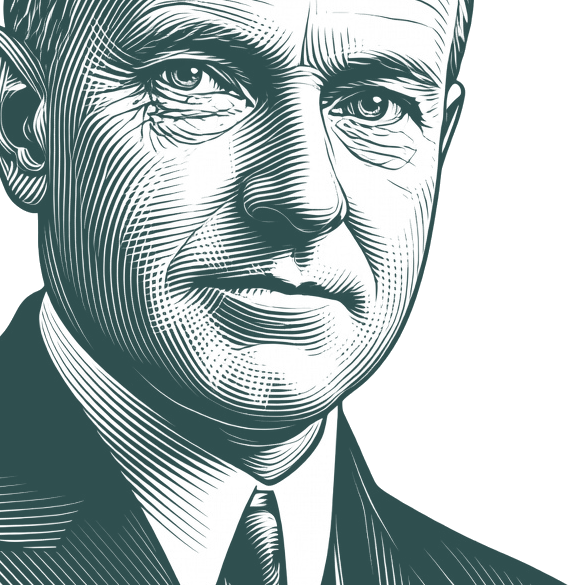
All growth depends upon activity. There is no development physically or intellectually without effort and effort means work. - Calvin Coolidge
""
All growth depends upon activity. There is no development physically or intellectually without effort and effort means work.
English
Collect this quote
About
Calvin Coolidge
John Calvin Coolidge Jr. (4 July 1872 – 5 January 1933) was the 30th president of the United States (1923–29). A Republican lawyer from Vermont, Coolidge worked his way up the ladder of Massachusetts state politics, eventually becoming governor of that state. His response to the Boston Police Strike of 1919 thrust him into the national spotlight and gave him a reputation as a man of decisive action. Soon after, he was elected as the 29th vice president in 1920 and succeeded to the presidency upon the sudden death of Warren G. Harding in 1923. Elected in his own right in 1924, he gained a reputation as a small-government conservative.
Biography information from
Wikiquote·
Portrait adapted from
Wikimedia Commons, Harris & Ewing (Public domain / CC0)
Also Known As
Birth Name:
John Calvin
Alternative Names:
John Calvin Coolidge Jr.
•
John Calvin Coolidge
•
President Coolidge
•
J. C. Coolidge
•
C. Coolidge
•
Silent Cal
•
Silent Cal Coolidge
The words of a President have an enormous weight and ought not to be used indiscriminately.
When dealing with the distribution of powers between the General Government and the States, Chief Justice Marshall declared: 'When the American people created a national legislature, with certain enumerated powers, it was neither necessary nor proper to define the powers retained by the States. Those powers proceed, not from the people of America, but from the people of the several States, and remain after the adoption of the Constitution what they were before, except in so far as they may be abridged by that instrument'.