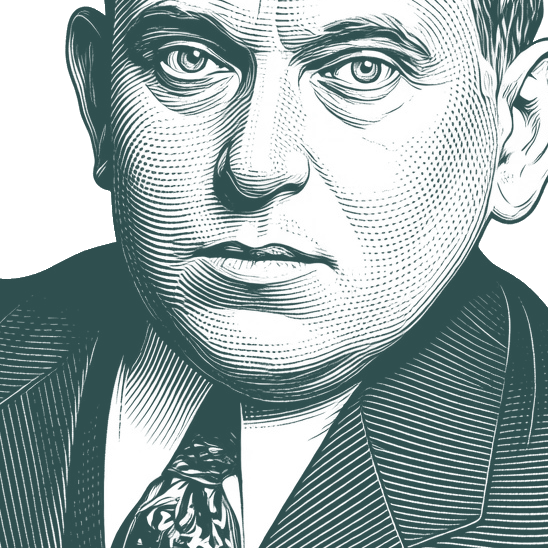
Henry Louis Mencken (12 September 1880 – 29 January 1956), known as H. L. Mencken, was a twentieth-century journalist, satirist, social critic, cynic, and freethinker, known as the "Sage of Baltimore" and the "American Nietzsche". He is often regarded as one of the most influential American writers of the early 20th century.
Portrait adapted from
Wikimedia Commons, Ben Pinchot (Public domain / CC0)
What is not true, as everyone knows, is always immensely more fascinating and satisfying to the vast majority of men than what is true. Truth has a harshness that alarms them, and an air of finality that collides with their incurable romanticism.
Democracy always seems bent upon killing the thing it theoretically loves. I have rehearsed some of its operations against liberty, the very cornerstone of its political metaphysic. It not only wars upon the thing itself; it even wars upon mere academic advocacy of it. I offer the spectacle of Americans jailed for reading the Bill of Rights as perhaps the most gaudily humorous ever witnessed in the modern world. Try to imagine monarchy jailing subjects for maintaining the divine right of Kings! Or Christianity damning a believer for arguing that Jesus Christ was the Son of God! This last, perhaps, has been done: anything is possible in that direction. But under democracy the remotest and most fantastic possibility is a common place of every day. All the axioms resolve themselves into thundering paradoxes, many amounting to downright contradictions in terms. The mob is competent to rule the rest of us—but it must be rigorously policed itself. There is a government, not of men, but of laws—but men are set upon benches to decide finally what the law is and may be. The highest function of the citizen is to serve the state—but the first assumption that meets him, when he essays to discharge it, is an assumption of his disingenuousness and dishonour. Is that assumption commonly sound? Then the farce only grows the more glorious. I confess, for my part, that it greatly delights me. I enjoy democracy immensely. It is incomparably idiotic, and hence incomparably amusing. Does it exalt dunderheads, cowards, trimmers, frauds, cads? Then the pain of seeing them go up is balanced and obliterated by the joy of seeing them come down. Is it inordinately wasteful, extravagant, dishonest? Then so is every other form of government: all alike are enemies to laborious and virtuous men. Is rascality at the very heart of it? Well, we have borne that rascality since 1776, and continue to survive. In the long run, it may turn out that rascality is necessary to human government, and even to civilization itself—that civilization, at bottom, is nothing but a colossal swindle. I do not know: I report only that when the suckers are running well the spectacle is infinitely exhilarating. But I am, it may be, a somewhat malicious man: my sympathies, when it comes to suckers, tend to be coy. What I can't make out is how any man can believe in democracy who feels for and with them, and is pained when they are debauched and made a show of. How can any man be a democrat who is sincerely a democrat?
Unlimited Quote Collections
Organize your favorite quotes without limits. Create themed collections for every occasion with Premium.
"I think there is a limit beyond which free speech can't go….a limit that is very seldom mentioned. It's the point where free speech begins to collide with the right to privacy… I don't think there are any other conditions to free speech. I have the right to say and to believe anything I please, but I don't have the right to press it on anybody else. For example, take for instance the Catholic Church, which I am on good terms with, personally, but which I have no belief in whatsoever. I have a right to print my dissent from its doctrines, to utter them. I have exercised that right for many years. But I have no right to go on the cathedral steps on Sunday morning, when the Catholics are coming out from High Mass, and make a speech denouncing them. I don't think there is any such right. Nobody has got the right to be a nuisance to his neighbors, or to hurt his neighbor's feelings wantonly. If they come to him and say "What do you think of this Mass that we have just finished?", I think that he has the right to answer. But he has no right to press his opinions on them. Of course you'll notice the peculiar thing about the United States, where there is very little free speech. Free speech is a very limited right, in this country, as I have learned to my bitter experience, more than once. Yet, it is the country where the right to press opinions on reluctant hearers is carried to a development that is unheard of on earth. The whole country's full of propagandists who are bothering everybody, all the time."