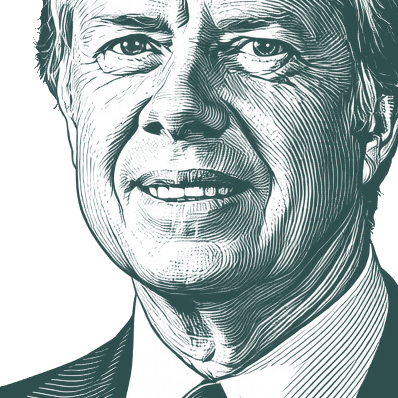
There is a strong religious commitment to the sanctity of human life, but, paradoxically, some of the most fervent protectors of microscopic stem cel… - Jimmy Carter
""
There is a strong religious commitment to the sanctity of human life, but, paradoxically, some of the most fervent protectors of microscopic stem cells are the most ardent proponents of the death penalty.
English
Collect this quote
About
Jimmy Carter
James Earl Carter, Jr. (October 1, 1924 – December 29, 2024) was an American politician and member of the Democratic Party who served as the 39th president of the United States from 1977 to 1981. In 1982 he established the Carter Center, as a base for promoting human rights, democracy, finding peaceful solutions to international conflicts, and advancing economic and social development, for which he was awarded the Nobel Peace Prize in 2002. He was a key figure in the Habitat for Humanity project, and has been noted for his criticism of Israel's role in the Israeli–Palestinian conflict.
Biography information from
Wikiquote·
Portrait adapted from
Wikimedia Commons, Department of Defense. Department of the Navy. Naval Photographic Center (Public domain / CC0)
Also Known As
Birth Name:
James Earl Carter Jr.
Alternative Names:
James E. Carter
•
James Carter
•
James Earl Carter
•
39th President of the United States
•
James E. Carter Jr.
•
James Earl Carter, Jr.
•
James E. Carter, Jr.
Portrait from Wikimedia Commons. Credit: Department of Defense. Department of the Navy. Naval Photographic Center. Used under Public domain / CC0. Processed and styled by Quotewise.
Works in ChatGPT, Claude, or Any AI
Add semantic quote search to your AI assistant via MCP. One command setup.
Today, I want to talk to you briefly about some domestic problems which prey on my mind and rest on my shoulders as your President. The domestic problems which we do face as Americans are difficult, indeed, but we have the courage and the ingenuity and the greatness of spirit to meet these challenges. I believe that we can build an America in which our day-to-day practices live up to our democratic ideals, in which the family life, mine and yours, is strong and stable, in which the neighborhoods of our cities are vital and safe, in which work is available and is justly rewarded, in which opportunity is not limited by color or sex or religion or economic or educational background, in which there is schooling and employment for the young and dignity and security for the old. We must work together to control inflation and to get our economy moving again. We must come to terms with the growing shortage of energy which, if ignored, will gravely damage the very fabric of our society. We must safeguard the integrity of our social security system. We must totally reform our tax and our welfare systems. We must ensure the health of the American people. And we must develop a government which is open enough to earn the trust and support of the people in addressing these and other crucial issues, and efficient enough and competent enough to ensure that our efforts will bear fruit.
I think it's very significant to point out that several Presidents and several different Congresses, that many private contributors have been involved in the evolution of this tremendous new health care center. I'm proud of it. It has been a subject of some criticism because of its cost. But I think we have to remember that this is the center of our government, and that what does occur here in 1977 and in the year 2000 can very well set a standard of care and love for children that will permeate the consciousness of doctors and nurses and parents, teachers and social workers throughout our country and, perhaps, even throughout the world. I grew up in a home in a rural area of Georgia, but my mother was a registered nurse. And I and the other children in that country community had good health care, not just from her but because there was a heavy emphasis on the prevention of disease, on inoculations, and on a constant relationship with a large number of medical doctors who lived there then.
Enhance Your Quote Experience
Enjoy ad-free browsing, unlimited collections, and advanced search features with Premium.
Also, we need tax reduction and tax reform. They go together. They add up to $25 billion in net cuts in the income taxes Americans have to pay, and they are also designed to create an additional 1 million new jobs. Seventeen billion dollars of this tax cut will be for working families in our country, personal income tax reductions, and the rest in corporate tax reductions. Corporations will also receive higher tax credits for investing in the sort of new plants, new equipment that will make New England and the rest of the Nation competitive with aggressive foreign exports. But we can't have these cuts in taxes unless we help pay for them by eliminating some of our unnecessary and unwarranted income tax subsidies. Two of these are the deferral subsidy and the DISC subsidies. Both have a particularly bad effect in New England, where competition from abroad has had such a terrible effect on businessmen and on workers alike. The deferral subsidy sets a situation in effect where multilateral corporations pay lower taxes on foreign profits than they pay on their U.S. profits. This amounts to subsidizing corporations to export jobs overseas. The so-called DISC subsidies are just as bad. They let U.S. corporations set up dummy corporations to handle foreign exports, so as to keep from paying U.S. taxes on half their profits. Both these giveaways go overwhelmingly to a few of the largest multinational corporations, and both mean that the average taxpayer has to pay the bill, more taxes, just to take up the slack caused by these subsidies. And both cost America, and particularly New England, jobs. Both loopholes should be closed. As for the famous three-martini lunch, I don't care how many martinis anyone has with lunch, but I am concerned about who picks up the check. I don't think a relatively small minority has some sort of divine right to have expensive meals, free theater tickets, country club dues, sporting events tickets paid for by heavier taxes on everybody else. If the Congress will help me by getting rid of these tax loopholes and by enacting the entire economic program, we can have a good start on correcting unemployment and inflation. The economy won't turn around overnight, of course, any more than an ocean liner can turn around on a dime. The job will require slow, careful planning, not dramatic master strokes. It will require small corrections, of course, that we adhere to very patiently. It will require careful planning, careful adjustment, careful tuning and cooperation. The machinery of the American economy is sound. We have a lot to be thankful for. It's worked well despite severe shocks, but it can work better, and that's our major goal in this country this year.